

If you are weighing a 15 year mortgage or 30 year mortgage, the standard advice — "take the 15-year if you can afford it" — was written for one predictable paycheck, not for compensation that swings with a vesting schedule and a Q4 bonus. A tech executive earning $400,000 on paper might have $220,000 of that locked in RSUs that fluctuate with a stock price. Run the 15-year mortgage vs 30-year mortgage math on base salary alone and the answer looks very different than if you assume every dollar of projected comp arrives on schedule.
Key Takeaways
- A 15-year mortgage typically carries a rate roughly 0.5–0.75 points lower than a 30-year mortgage on the same day.
- The 15-year's higher required payment acts as automatic forced savings — you cannot skip building equity.
- Total interest paid on a 30-year mortgage often runs two to two-and-a-half times higher than on a 15-year loan.
- A 30-year mortgage's lower required payment preserves cash flow flexibility that variable-comp earners often need.
- The "executive hybrid strategy" takes a 30-year mortgage but pays extra principal on a 15-year-like schedule when cash allows.
The Executive's Version of the 15-Year vs 30-Year Mortgage Dilemma
Most articles frame the 15 year mortgage or 30 year mortgage choice as a pure interest-rate question, which mostly works for a salaried buyer with predictable income. A tech executive's income structure breaks that assumption. Base salary might cover a comfortable 30-year payment with room to spare, but a 15-year payment only works if bonus and RSU income arrive reliably and at the value your grant assumed. Run your base-salary-only scenario through our mortgage calculator so the comparison reflects income you can count on.
The stakes are also higher in dollar terms. Tech executives tend to buy in expensive coastal markets, so the gap between a 15-year and 30-year payment on a $900,000 or $1.2 million loan isn't a rounding error — it can run $2,000 to $3,500 a month, either locked into the house or available for investing, a mega-backdoor Roth contribution, or a cash cushion between vesting events.
Lower Interest Rates: What a 15-Year Mortgage Actually Saves
The single biggest reason people lean toward a 15-year mortgage vs 30-year mortgage is the rate itself. Lenders take on less default risk over a shorter term, so 15-year rates typically run about half a point to three-quarters of a point below 30-year rates — a gap that has held fairly consistently through 2026. On a large executive-sized loan, that spread alone can be worth hundreds of dollars a month before you even account for the faster payoff. It's the cleanest, least debatable advantage a 15-year loan offers.
What the rate spread does not capture is how the two loans behave differently as your career progresses. A tech executive five years from a likely IPO liquidity event or acquisition payout might value a lower guaranteed rate today less than the option to redirect cash toward equity concentration risk management. Rate is one input, not the whole decision — which is exactly why the sections below matter as much as the number on the term sheet.
Forced Savings: The Discipline a 30-Year Mortgage Doesn't Give You
A 15 year mortgage works like an automatic savings plan you cannot opt out of. Because the required payment is higher and more principal is retired every month, equity builds fast whether or not you would have voluntarily redirected that cash toward investing on your own. For executives whose free cash flow tends to get absorbed by lifestyle creep or an ambitious angel-investing habit, that forced structure has real behavioral value — the house disciplines the spending decision for you.
A 30-year mortgage offers no such guardrail. Its lower required payment frees up cash, but freed-up cash only builds wealth if you actually invest or save it. Plenty of high earners intend to put the difference into a brokerage account and instead watch it absorb into a higher mortgage on the next home, a larger car payment, or simply a higher baseline of monthly spending. If you know your own discipline is inconsistent, that alone is a real argument for the 15-year structure.
Total Cost: What a 15-Year vs 30-Year Mortgage Really Costs Over Time
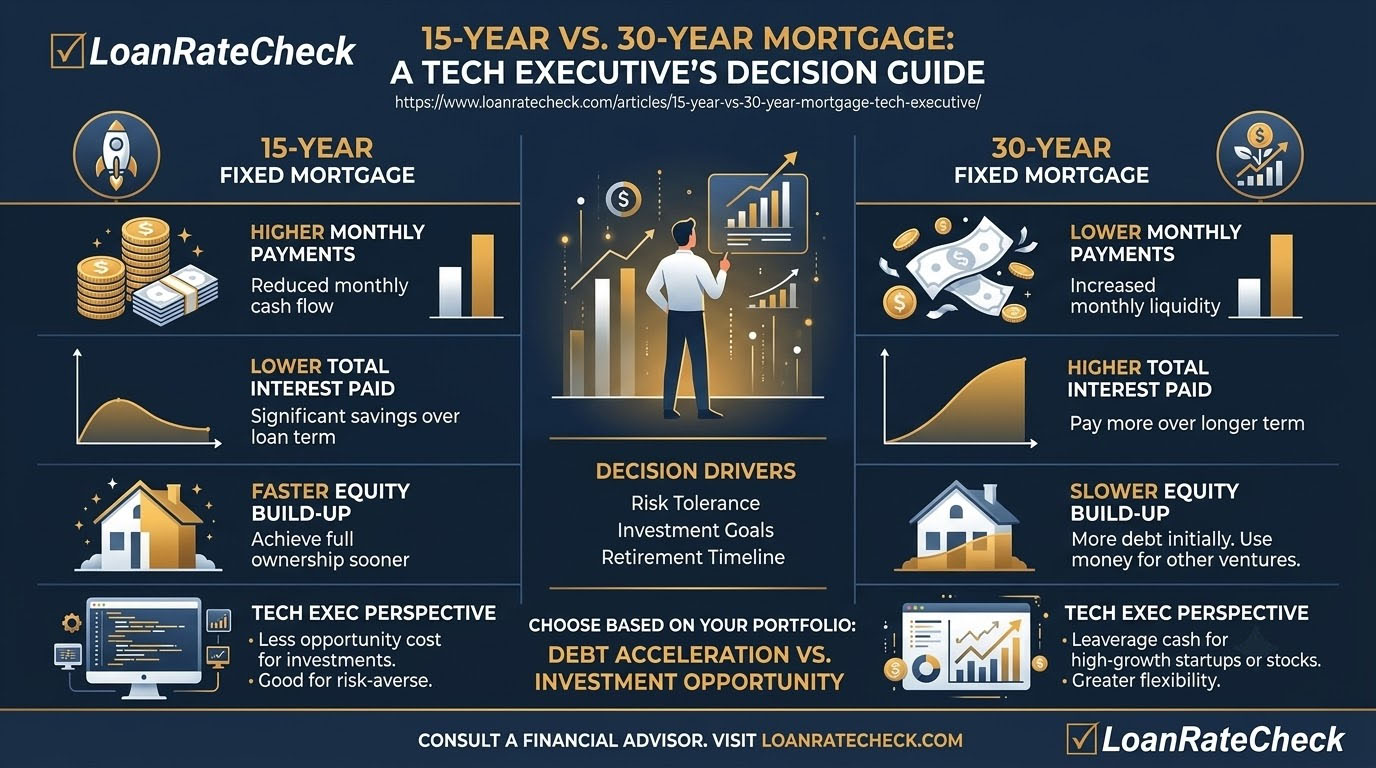
Run the numbers on a $900,000 loan and the gap is dramatic. At roughly 6.0% over 15 years, principal and interest lands near $7,595 a month, with total interest around $467,000. The same balance over 30 years at roughly 6.65% runs closer to $5,780 a month — smaller, but total interest climbs to about $1.18 million, more than double. That's the entire case for a 15 year mortgage in one comparison — run it with your own numbers on our mortgage calculator.
The monthly gap in this example is about $1,815 — money that either goes toward a faster mortgage payoff or stays liquid every single month for thirty years. Multiply that by 360 months and you get a sense of the real scale of the decision: it is not a rounding error on a term sheet, it is one of the largest recurring financial commitments most executives will make outside of taxes themselves.
The Catch Behind a 15-Year Mortgage's Lower Total Cost
The catch is easy to underweight when you're staring at a lower total-interest number: a 15-year mortgage's payment is fixed and non-negotiable, regardless of what your compensation does. If your company has a rough year, your RSU value drops, or a bonus gets deferred, that payment doesn't shrink to match. For a household leaning on variable comp to make a 15-year payment work, one bad year can turn a "smart" decision into real stress — especially if it collides with a market downturn that also dents your investments.
This is also where veteran home loan lenders and mortgage underwriters generally push back hardest: many lenders qualify variable-comp borrowers more conservatively, averaging bonus and RSU income over two years rather than counting the most recent, highest number. Check current rates here and ask any lender you're considering exactly how they treat equity compensation before you commit to a shorter, higher-payment term.
Cash Flow Flexibility: The 30-Year Mortgage's Real Advantage
A 30 year mortgage's lower required payment is not just a smaller number on paper — it is optionality. In a strong bonus year, you can pay extra toward principal. In a lean year, or one funding a down payment on a second property, you can pay only the required minimum with zero risk of default. That flexibility matters to anyone whose income is naturally lumpy, and it's the biggest reason sophisticated, high-income buyers still choose 30-year terms more often than the simple math would suggest.
The trade-off is that flexibility only pays off if you use it deliberately. A 30-year mortgage taken purely for the lower payment, with no plan to redirect the difference toward investing or extra principal, ends up being the objectively more expensive choice for no real benefit. The flexibility is a tool, not a guarantee — it works only if paired with intention.
Opportunity Cost Advantage: Investing the Payment Difference
This is where the 15 year mortgage or 30 year mortgage debate gets genuinely interesting for an executive with equity comp and tax-advantaged accounts. If your mortgage rate sits meaningfully below long-run diversified market returns, the argument for a 30-year mortgage plus investing the difference has real support — every dollar of extra principal is a dollar not compounding elsewhere. Historically, diversified equity returns have outpaced typical mortgage rates over long holding periods, though that gap has narrowed as rates rose through the mid-2020s.
The honest caveat: that math assumes disciplined, consistent investing of the difference and a market return that is never guaranteed. A tech executive already holding concentrated company stock through RSUs is taking on real equity-market risk in their compensation already — stacking more market exposure by skipping mortgage paydown compounds that concentration rather than diversifying away from it. This is a legitimate reason some executives prefer the guaranteed, risk-free "return" of a 15-year payoff instead, even when the pure numbers slightly favor investing.
Liquidity Protection: Why Home Equity Isn't Cash
Home equity, however much of it you build through a 15-year mortgage's faster paydown, is illiquid — you can't spend it without selling, refinancing, or opening a home equity line, each of which takes time. For an executive who may need cash quickly, to exercise options before they expire, cover a vesting-event tax bill, or seize an investment opportunity, a 30-year mortgage's preserved liquidity can matter more than the interest saved. Cash in a brokerage account is available in days; equity trapped in a house is not.
The Consumer Financial Protection Bureau's guidance on homebuying and mortgage decisions makes a similar point: the "right" mortgage term depends on your full financial picture, not just the interest rate on offer. For executives with concentrated equity risk and irregular cash flow, liquidity protection is a legitimate, quantifiable reason to accept a somewhat higher total interest cost.
15-Year Mortgage vs 30-Year Mortgage: Side-by-Side Comparison
15 Year Mortgage vs 30 Year Mortgage — Key Differences
| Feature | 15-Year Mortgage | 30-Year Mortgage |
|---|---|---|
| Typical rate | ~0.5–0.75 pts lower | Higher, more common |
| Monthly payment | Higher, fixed | Lower, more flexible |
| Total interest paid | Roughly 50%–60% less | 2–2.5x the 15-year total |
| Equity buildup | Fast, forced | Slower, optional to accelerate |
| Best fit for | Stable, predictable income | Variable comp, bonus/RSU-heavy income |
Figures are illustrative and vary by lender, credit profile, and current rate environment. Confirm exact terms with a mortgage lender before deciding.
The Executive Hybrid Strategy: Take the 30-Year, Pay Like It's a 15
Most 30-year mortgages allow extra principal payments with no prepayment penalty, which means you are not actually choosing between a 15 year mortgage or 30 year mortgage forever — you're choosing your floor. The hybrid approach sets the 30-year payment as a floor you can always meet even in a rough year, then treats anything above that as optional acceleration whenever cash allows. In a strong bonus year, you might pay the equivalent of 15-16 payments. In a lean year, you pay the required minimum and nothing more, with zero risk of default.
The trade-off is that you never lock in the lower 15-year rate, so you give up part of the rate advantage while keeping most of the payoff-speed advantage. For many tech executives, that trade is worth it: skipping acceleration in a bad year is worth more than the incremental rate savings, especially when income is tied to a stock price you don't control. Model both the strict 15-year payment and the hybrid schedule side by side on our mortgage calculator before committing.
There is no universally correct answer to the 15 year mortgage or 30 year mortgage question — it depends on whether your income looks like a steady line or a series of spikes tied to a vesting calendar. A 15-year mortgage wins on total cost and forced discipline. A 30-year mortgage wins on flexibility and liquidity, especially for anyone already carrying concentrated equity risk. For most tech executives, the hybrid strategy — a 30-year floor with disciplined extra payments — captures the best of both without betting housing stability on a bonus that hasn't landed yet.
Frequently Asked Questions
What is the main advantage of a 15-year fixed rate loan versus a 30-year fixed rate loan?
The main advantage of a 15-year fixed-rate loan is the combination of a lower interest rate and a dramatically shorter payoff timeline, which together cut total interest cost by roughly half compared to a 30-year loan on the same balance. The trade-off is a materially higher required monthly payment, since the same principal is repaid in half the time.
Is a 15-year mortgage or 30-year mortgage better for a high-income tech executive?
There is no universal answer, because it depends on income stability, not just income size. An executive with steady base salary and predictable cash flow can often handle a 15-year mortgage comfortably, while one whose pay leans heavily on RSU vesting or bonus timing usually benefits from a 30-year mortgage's lower required payment paired with voluntary extra principal payments when cash flow allows.
How much more does a 30-year mortgage cost than a 15-year mortgage?
On a comparable loan balance, a 30-year mortgage typically costs roughly two to two-and-a-half times more in total interest than a 15-year mortgage, driven by both the longer payoff period and the modestly higher interest rate 30-year loans usually carry. The exact gap depends on your rate, loan amount, and how the rate spread between the two terms looks when you lock.
Can I pay off a 30-year mortgage on a 15-year schedule?
Yes. Most 30-year mortgages allow additional principal payments with no prepayment penalty, so you can voluntarily pay extra each month or year to approximate a 15-year payoff timeline while keeping the lower required minimum payment as a safety net. You will not get the lower 15-year interest rate this way, but you keep full flexibility to scale payments up or down as your cash flow changes.
What is the executive hybrid mortgage strategy?
The executive hybrid strategy means taking a 30-year mortgage for its lower required payment and built-in flexibility, then voluntarily paying extra principal during high-cash-flow months, such as after a bonus or RSU vest, to shorten the effective payoff timeline closer to 15 years. It captures much of the interest savings of a 15-year loan without locking in a payment that becomes a problem during a lower-cash-flow year.
Does a 15-year mortgage always have a lower interest rate than a 30-year mortgage?
In almost all market conditions, yes — 15-year mortgage rates run below 30-year mortgage rates because lenders take on less default risk over a shorter term. The gap between the two typically runs about half a percentage point to three-quarters of a percentage point, though it narrows or widens somewhat with broader interest rate movements.
Ready to Compare Your 15-Year and 30-Year Options?
Use LoanRateCheck's free mortgage calculator to model both terms side by side — monthly payment, total interest, and a custom extra-payment schedule — all in one place, with no registration required.
Open the Mortgage Calculator →