

VA home loans for veterans are guaranteed by the Department of Veterans Affairs and issued by private veteran home loan lenders — banks, credit unions, and mortgage companies approved to originate them. The VA does not lend the money itself; it backs a portion of the loan, which is why lenders can offer $0 down payment, no private mortgage insurance, and often more flexible credit standards than a conventional mortgage. That guarantee is powerful, but it comes with its own rulebook — occupancy requirements, a funding fee, and a cap on what sellers can contribute — that every buyer should understand before shopping rates.
Key Takeaways
- A VA backed home loan typically requires $0 down and never charges monthly private mortgage insurance.
- Most borrowers pay a one-time VA funding fee between 1.25% and 3.3% of the loan amount.
- Seller concessions are capped by the "4% rule," though normal closing costs are not.
- VA mortgage lenders use residual income, not just DTI, to judge affordability.
- The property must be your primary residence — VA loans cannot fund investment properties.
What Is a VA Home Loan?
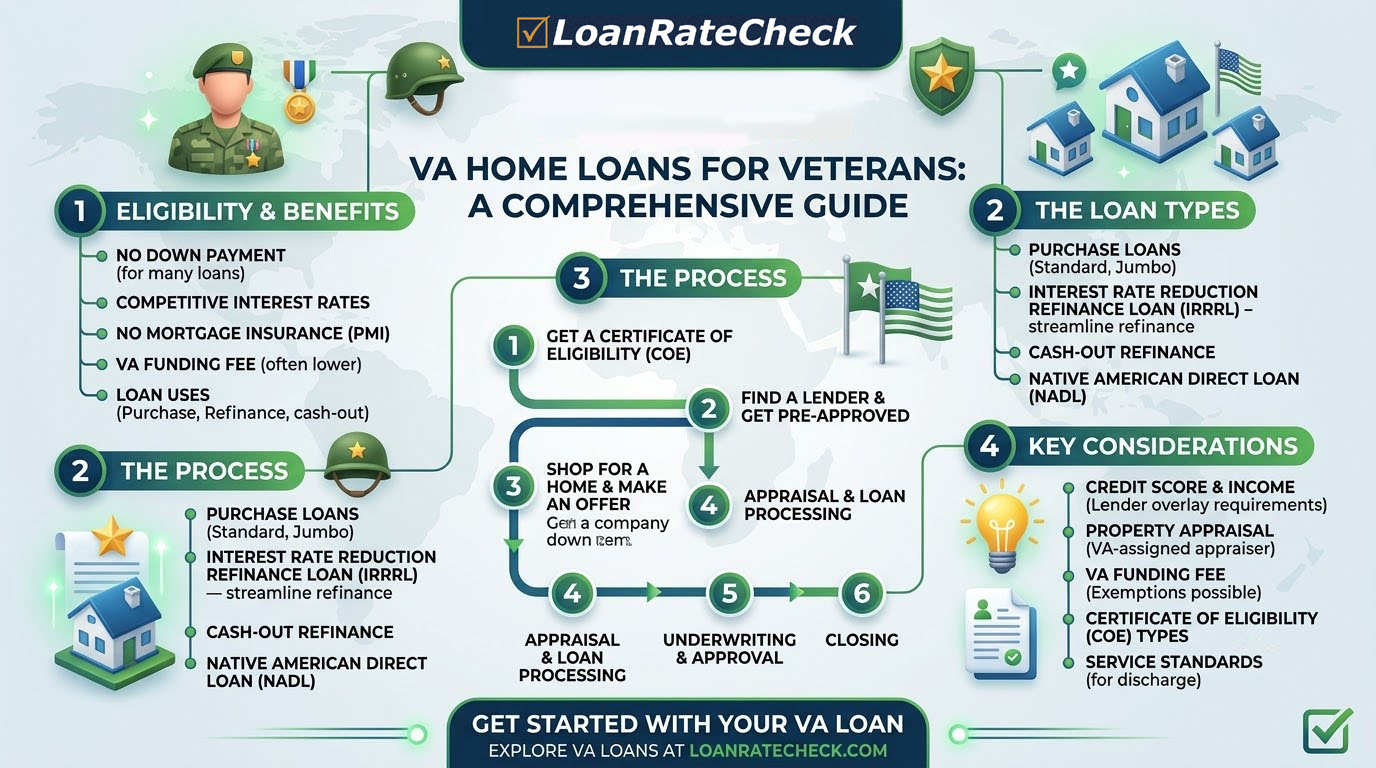
A VA home loan is a mortgage guaranteed by the Department of Veterans Affairs and available to eligible veterans, active-duty service members, National Guard and Reserve members, and certain surviving spouses. The guarantee protects the lender against a portion of the loss if the borrower defaults, which is exactly what allows veteran home loan lenders to approve buyers with no down payment. To use the benefit, you first need a Certificate of Eligibility (COE), which confirms your service history meets the VA's minimum requirements and shows how much entitlement you have available for the guarantee. You can check your eligibility and request a COE directly through the Department of Veterans Affairs.
Unlike an FHA or USDA loan, a VA backed home loan has no maximum loan limit tied to the guarantee itself — your borrowing power depends instead on your income, credit, and how much entitlement you have remaining if you have used the benefit before. You can use a VA loan more than once in your lifetime, and in many cases even hold more than one VA loan at a time if you have sufficient entitlement left. Our VA mortgage calculator can help you translate any loan amount into a real monthly payment before you get preapproved.
How VA Backed Home Loans Work With VA Mortgage Lenders
The VA does not process your application, verify your income, or fund your closing — a private lender does all of that. VA mortgage lenders pull your credit, review your residual income, order the VA appraisal, and fund the loan just like they would on a conventional mortgage. The VA's role is limited to guaranteeing a portion of the loan against default, issuing your COE, and reviewing the appraisal for the property's "reasonable value." Because of that guarantee, lenders can safely skip the down payment and monthly mortgage insurance that conventional loans require below 20% equity.
Not every bank is approved to originate VA loans, and among those that are, underwriting overlays differ significantly. One lender might approve a 580 credit score; another might require 620 or higher even though the VA itself sets no minimum score. This is why comparing quotes from at least two or three veteran home loan lenders matters — the government guarantee is identical everywhere, but the rate, fees, and approval flexibility are not. Check current rates here before settling on a single lender.
What Are the Rules for a VA Mortgage?
The core rules for a VA mortgage start with occupancy: the home must be your primary residence, and you are generally expected to move in within 60 days of closing. Investment properties and vacation homes are not eligible. Beyond occupancy, most first-time users pay a one-time VA funding fee of 2.15% of the loan amount with no down payment, dropping to 1.5% with 5% or more down and 1.25% with 10% or more down. Subsequent users of the benefit pay a higher 3.3% fee at $0 down, though that penalty disappears once a down payment of 5% or more is made. Veterans with a service-connected disability rating of 10% or higher, along with certain Purple Heart recipients and surviving spouses receiving DIC, are exempt from the fee entirely.
Affordability under a VA mortgage is judged differently than under a conventional loan. Rather than relying purely on a debt-to-income ceiling, veteran home loan lenders also calculate residual income — the cash left over each month after your proposed mortgage, taxes, insurance, and existing debts. The VA publishes regional residual income minimums by family size, and a borrower whose DTI runs above roughly 41% needs residual income at least 20% above that regional floor to still qualify. This dual test is one reason VA approvals sometimes succeed where a conventional lender's strict DTI cutoff would decline the same borrower.
What Disqualifies You From a VA Loan?
A handful of factors commonly disqualify a borrower from a VA backed home loan. Not meeting the VA's minimum service requirement — generally 90 continuous days of active duty during wartime, 181 days during peacetime, or six years in the Guard or Reserve — is the most fundamental barrier, since it means no COE can be issued. A dishonorable discharge also blocks eligibility outright, while other-than-honorable discharges may require a separate discharge upgrade or character-of-service review before a COE can be granted.
Beyond service eligibility, lenders will decline or delay an application for a recent foreclosure or bankruptcy that hasn't cleared the required waiting period (typically two years, sometimes shorter with documented extenuating circumstances), insufficient or unverifiable income, a debt-to-income and residual income combination that doesn't clear the VA's thresholds, or a property that fails the mandatory VA appraisal for minimum property requirements. Buying a second home, an investment property, or a condo in a complex that isn't VA-approved will also disqualify that specific transaction, even if you personally remain eligible for the benefit.
What Is the Downside of a VA Loan?
The most-cited downside of a VA loan is the funding fee itself — a cost conventional buyers with 20% down never pay. Rolling that fee into the loan balance, which most borrowers do, means paying interest on it for the life of the mortgage. The primary-residence requirement is another real limitation: you cannot use a VA backed home loan to buy a rental property or a second home, which rules it out for buyers focused purely on investment real estate. Sellers in competitive markets also sometimes hesitate over VA offers due to outdated assumptions about appraisal timelines and minimum property requirements, even though VA closing timelines are typically comparable to conventional loans today.
A less obvious downside is that not every property qualifies. Homes must clear the VA's minimum property requirements for safety, soundness, and sanitation, which can require repairs a conventional or cash buyer would happily skip. Condos must appear on the VA's approved project list unless the buyer pursues a spot approval, which not every lender will pursue. None of these downsides eliminate the loan's value for eligible veterans, but they explain why a VA backed home loan isn't automatically the cheapest or fastest option in every single transaction.
What Is the 4% Rule on a VA Loan?
The VA's 4% rule is one of the most misunderstood pieces of a VA mortgage. It does not cap how much a seller can pay toward your closing costs overall. Instead, the VA splits seller contributions into two separate buckets. Bucket one is ordinary closing costs — the origination fee, appraisal, title work, and recording fees — and a seller can pay all of it with no percentage limit. Bucket two is "seller concessions," defined as anything of value beyond normal closing costs: paying off a buyer's credit card or car loan, prepaying more than a year of property taxes, funding a temporary rate buydown, or covering the VA funding fee. That second bucket is capped at 4% of the home's reasonable value as shown on the VA's Notice of Value.
On a $350,000 home, that means the seller could pay every allowable closing cost with no limit, then add up to $14,000 more in concessions — potentially wiping out the buyer's funding fee and cash-to-close entirely. Where buyers get caught off guard is when a lender misclassifies items, lumping ordinary closing costs into the 4% bucket and shrinking the negotiating room unnecessarily. If a deal's seller credits are close to the 4% threshold, ask your loan officer to walk through exactly which line items count before you finalize the purchase agreement.
How Much Income Do You Need to Qualify for a $200,000 Mortgage?
At a 7% rate on a 30-year term, the principal-and-interest payment on a $200,000 mortgage is approximately $1,331 per month. Add typical property taxes and homeowners insurance and a realistic total housing payment lands closer to $1,650–$1,750 per month. Using the VA's roughly 41% debt-to-income guideline with no other monthly debts, that translates to a gross monthly income around $4,100–$4,300 — or about $50,000–$52,000 a year. Add a car payment or student loan and the required income climbs quickly, which is exactly why lenders check residual income alongside DTI rather than DTI alone — a distinction the Consumer Financial Protection Bureau also flags as a key affordability metric across all mortgage types.
The same math applied in reverse shows how much home a $40,000 salary can support. At $3,333 in gross monthly income, a 41% DTI ceiling allows roughly $1,367 in total monthly debt. After setting aside an estimated $250 for taxes and insurance, that leaves about $1,117 for principal and interest — enough to support a loan in the neighborhood of $160,000–$175,000 at 7%, depending on the exact tax rate, insurance cost, and any existing debt payments. Run your own numbers with different rates and loan amounts using our VA mortgage payment calculator rather than relying on rules of thumb alone.
VA Backed Home Loan vs Conventional Loan
VA Loan vs Conventional Loan — Key Differences
| Feature | VA Backed Home Loan | Conventional Loan |
|---|---|---|
| Down payment | $0 in most cases | 3%–20%+ |
| Monthly PMI | None | Required below 20% down |
| One-time fee | VA funding fee (1.25%–3.3%)* | None (unless points purchased) |
| Occupancy | Primary residence only | Primary, second home, or investment |
| Underwriting basis | DTI plus residual income | DTI ratio only |
* Waived for veterans with a service-connected disability rating of 10% or higher. Figures are illustrative — confirm current terms with your lender.
Is It Difficult to Get a VA Home Loan?
For an eligible veteran with a COE, stable income, and reasonable credit, a VA home loan is generally no harder to get than a conventional mortgage — and for buyers without much cash saved for a down payment, it is often considerably easier. The VA itself sets no minimum credit score, though most VA mortgage lenders apply their own overlay somewhere between 580 and 640. The steps that trip buyers up are rarely about eligibility itself: a late-arriving COE, a property that fails the VA appraisal's minimum requirements, or a condo that isn't on the VA's approved list can all slow a file down even when the borrower easily qualifies.
What actually makes the difference is preparation. Getting your COE early, choosing a lender experienced with VA files rather than one that only occasionally closes them, and confirming a condo or new-construction property meets VA standards before writing an offer all remove the most common friction points. Veteran home loan lenders who specialize in VA files tend to move faster and catch appraisal or entitlement issues earlier than lenders who treat VA loans as a side product.
What Do You Not Pay With a VA Loan?
Two costs stand out as things you will not pay with a compliant VA backed home loan. First, there is no down payment requirement in the vast majority of cases — you can finance up to 100% of the purchase price. Second, and often more valuable over time, there is no monthly private mortgage insurance, regardless of how little equity you put down; conventional borrowers below 20% equity pay PMI every month until they cross that threshold. VA rules also prohibit charging veterans for certain fees outright, including attorney fees for the lender's benefit, real estate broker fees, and several other "non-allowable" closing costs that must instead be absorbed by the lender or seller.
Whether you are buying your first home or using the benefit again, VA home loans for veterans remain one of the strongest paths to homeownership available in the U.S. mortgage market — no down payment, no monthly mortgage insurance, and underwriting that looks at your real cash flow rather than a single ratio. The rules around the funding fee, the 4% seller concession cap, and occupancy are not obstacles designed to trip you up; they are the framework that keeps the benefit sustainable for the veterans who use it after you. Understanding them before you shop is what separates a smooth VA closing from a stressful one.
Frequently Asked Questions
What is a VA home loan?
A VA home loan is a mortgage guaranteed by the U.S. Department of Veterans Affairs and issued by private veteran home loan lenders. The guarantee lets eligible veterans, active-duty service members, and certain surviving spouses buy a home with $0 down and no monthly private mortgage insurance. You need a Certificate of Eligibility (COE) to use the benefit, and the property must be your primary residence.
What is the downside of a VA loan?
The main downsides are the one-time VA funding fee (1.25%–3.3% of the loan amount for most borrowers), the requirement that the home be your primary residence, and the VA's minimum property requirements, which can require repairs some conventional buyers would skip. Condos also need VA project approval. None of these outweigh the benefit for most eligible veterans, but they are real costs and restrictions to plan around.
What is the 4% rule on a VA loan?
The 4% rule caps "seller concessions" — extras like paying off buyer debt, funding a rate buydown, or covering the VA funding fee — at 4% of the home's appraised value. It does not cap ordinary seller-paid closing costs like the origination fee, appraisal, or title work, which a seller can pay in full with no percentage limit. Many buyers and even some lenders mistakenly apply the 4% cap to all seller contributions, which isn't how the VA rule actually works.
What are the rules for a VA mortgage?
Core VA mortgage rules include occupying the home as your primary residence (generally within 60 days of closing), passing a VA appraisal for minimum property requirements, and paying a one-time funding fee unless you're exempt. Lenders also evaluate both your debt-to-income ratio and your residual income — the cash left over after your mortgage, taxes, insurance, and debts — using regional minimums published by the VA.
What disqualifies you from a VA loan?
Not meeting the VA's minimum service requirement, a dishonorable discharge, or lacking a valid Certificate of Eligibility will disqualify you from the benefit itself. For a specific transaction, a recent unresolved foreclosure or bankruptcy, insufficient income relative to debt and residual income requirements, a property that fails the VA appraisal, or a non-VA-approved condo can each disqualify that purchase even if you remain personally eligible.
How much income do I need to qualify for a $200,000 mortgage?
At 7% on a 30-year term, principal and interest on a $200,000 mortgage runs about $1,331 a month, or roughly $1,650–$1,750 with taxes and insurance included. Using the VA's roughly 41% debt-to-income guideline with no other debts, that suggests a gross income around $50,000–$52,000 a year, though your exact figure depends on your rate, local taxes, and existing debt payments.
How much home loan can I get on a $40,000 salary?
On a $40,000 salary — about $3,333 gross per month — a 41% debt-to-income ceiling allows roughly $1,367 in total monthly debt. After an estimated $250 for taxes and insurance, that leaves about $1,117 for principal and interest, which supports a loan in the range of $160,000–$175,000 at a 7% rate, depending on your exact tax rate, insurance cost, and other debts.
What is the monthly payment on a $200,000 mortgage at 7%?
The principal-and-interest payment on a $200,000 mortgage at 7% over 30 years is approximately $1,331 per month. Adding typical property taxes and homeowners insurance brings the full monthly housing payment closer to $1,650–$1,750, depending on your location and coverage. Use a mortgage calculator with your specific tax and insurance figures for a precise number.
Is it difficult to get a VA home loan?
For an eligible veteran with a valid COE, stable income, and reasonable credit, a VA home loan is generally no harder to get than a conventional mortgage — and often easier for buyers without a large down payment saved. The VA sets no minimum credit score, though most lenders apply their own overlay, commonly between 580 and 640. Friction usually comes from appraisal or condo-approval delays rather than eligibility itself.
What do you not pay with a VA loan?
With a compliant VA backed home loan, you typically do not pay a down payment or any monthly private mortgage insurance, regardless of your equity level. VA rules also prohibit charging borrowers for certain "non-allowable" fees, including attorney fees for the lender's benefit and real estate broker fees, which must be covered by the lender or seller instead.
Ready to Estimate Your VA Payment?
Use LoanRateCheck's free VA home loan calculator to model your VA loan payment, funding fee, and amortization schedule — all in one place, with no registration required.
Open the VA Mortgage Calculator →