

An interest only loan sounds almost too good to be true: pay just the interest for several years, keep hundreds of dollars a month in your pocket, and worry about the principal later. That description is accurate — but "later" is doing a lot of heavy lifting. This guide explains exactly how these loans work, walks through calculating interest only loan payments step by step, shows you what to look for when comparing interest only lenders, and helps you build a plan so the payment jump at the end of the interest only period does not catch you off guard.
Key Takeaways
- During the interest only period, your payment covers zero principal — your balance does not shrink unless you choose to pay principal only voluntarily.
- Calculating interest only mortgage payments is simple: loan balance × annual rate ÷ 12.
- When the interest only period ends, your payment recasts — often rising by 20–40% — so a clear exit strategy is non-negotiable.
- Interest only lenders typically require stronger credit, larger down payments, and documented reserves than standard mortgage lenders.
- Used strategically, interest only financing genuinely frees up cash flow — but it rewards planners, not procrastinators.
What Is an Interest Only Loan?
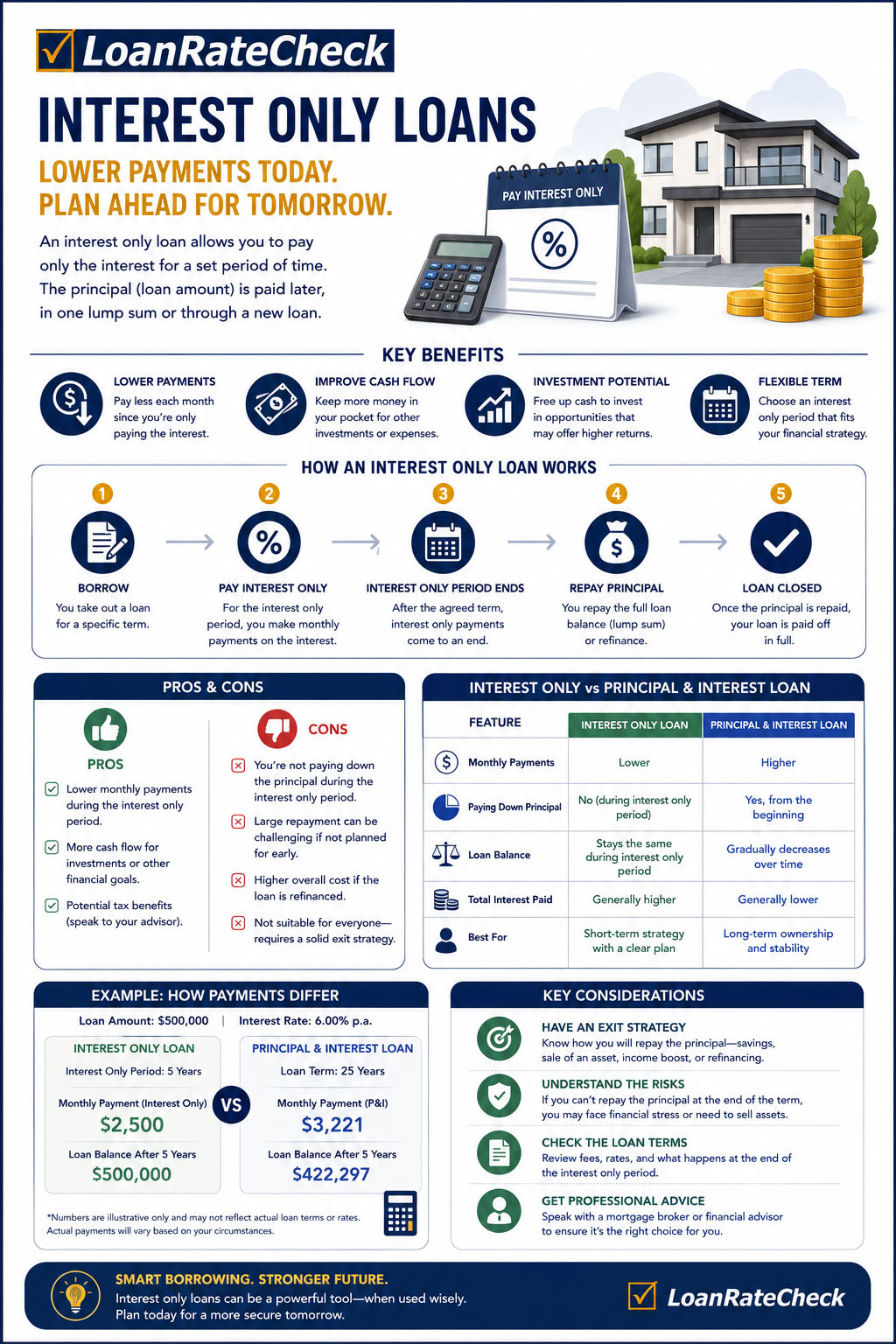
An interest only loan is a mortgage or personal loan where your required monthly payment covers only the interest charge — not the principal — for a defined period, usually 5 to 10 years. The principal balance stays exactly where it started unless you make optional extra payments. After the interest only period expires, the loan "recasts": the remaining balance is amortized over whatever years are left on the original term, and your payment increases accordingly. You can also refinance at that point, or sell the property if it is an investment.
These loans are most common in the jumbo and investment property markets, though some portfolio lenders offer them on primary residences to well-qualified borrowers. The appeal is straightforward — lower monthly outgo during the early years. The risk is equally clear: you are not building equity through repayment, and the eventual payment increase is real and sometimes substantial. That is not a reason to avoid them; it is a reason to understand them completely before signing.
How Interest Only Payments Actually Work
During the interest only period, your payment is determined by one simple formula applied each month to your outstanding balance. Because the balance does not decrease (absent voluntary extra payments), your required monthly payment stays flat throughout the interest only period — unlike a standard amortizing loan where the interest portion gradually declines. This flatness is both the feature and the hidden risk: comfortable and predictable up front, then a step change at recast.
The Three Phases of an Interest Only Loan
Phase one is the interest only period itself — typically 5–10 years of lower payments. Phase two is recast, when the loan switches to fully amortizing payments calculated on the original principal balance over the remaining term. Phase three is either payoff, sale, or refinance. Most borrowers who use interest only financing strategically never actually reach phase two — they sell or refinance before recast, which is a perfectly rational plan as long as it remains achievable when the time comes.
Calculating Interest Only Loan Payments: The Math
The formula for calculating interest only loan payments is genuinely simple, which is one of its underrated advantages for financial planning. You do not need an amortization table — just three numbers: your loan balance, your annual interest rate, and the number of payment periods per year (always 12 for monthly payments).
The Interest Only Payment Formula
Monthly interest only payment = Loan Balance × (Annual Interest Rate ÷ 12). That is it. A $500,000 loan at 7.0% annual interest produces a monthly payment of $500,000 × (0.07 ÷ 12) = $2,917. A $300,000 loan at 6.0% produces $300,000 × (0.06 ÷ 12) = $1,500. Because the formula is linear, you can scale it instantly for any balance or rate — no approximation needed. Use our free interest only loan calculator to run multiple scenarios and compare total interest cost across different loan amounts and rates.
What Changes After the Interest Only Period
After recast, the payment calculation switches to the standard amortization formula: M = P × [r(1+r)ⁿ] / [(1+r)ⁿ − 1], where P is your unchanged principal balance, r is the monthly rate, and n is the number of remaining payments. On that same $500,000 at 7.0% with 20 years remaining after a 10-year interest only period, the amortized payment becomes $3,876 — a $959 jump from the interest only amount. Calculating interest only mortgage scenarios through to recast is something most borrowers skip and later regret; the calculator link above models the full lifecycle in one view.
Can You Pay Principal Only During the Interest Only Period?
Yes — and this is one of the most underused strategies available to interest only borrowers. Most interest only loans allow voluntary extra principal payments at any time without penalty. When you pay principal only during the interest only phase, you reduce your outstanding balance immediately. That reduction has two effects: it lowers the base from which your required interest payment is calculated each month, and — crucially — it reduces the balance that gets amortized at recast, directly lowering the payment shock.
Think of it as having the best of both worlds: you get the lower required payment when cash is tight, but you retain the option to aggressively pay down principal when cash flow allows. Investors who use interest only financing strategically often route their payment savings straight into principal reduction during strong income months, effectively creating a flexible version of a standard amortizing loan. Before signing with any lender, confirm their prepayment policy in writing — most allow it freely, but some add restrictions. Our loan calculator lets you model the long-term impact of voluntary principal payments on your total interest cost and recast payment.
Finding the Right Interest Only Lenders
Not every lender offers interest only products, and those that do apply different qualification standards, rates, and terms. Knowing where to look — and what to compare — saves time and often thousands of dollars.
Where Interest Only Mortgages Are Available in 2026
Large national banks such as Wells Fargo, Chase, and Citibank offer interest only options primarily in their jumbo loan divisions, typically for loan amounts exceeding the conforming loan limit ($766,550 in most areas for 2024). Portfolio lenders — banks and credit unions that hold loans on their own books rather than selling them — are often more flexible on interest only terms and qualification criteria. Specialty mortgage lenders that focus on investment properties and high-net-worth borrowers represent a third category. According to the Consumer Financial Protection Bureau, interest only mortgages are classified as non-qualified mortgages (non-QM), which means they fall outside standard lending guidelines — a factor that narrows the pool of willing lenders but does not make them unavailable. Working with a mortgage broker who has relationships with multiple interest only lenders is often the fastest path to finding competitive offers. Check current rates from top lenders here to get a baseline before approaching individual banks.
What Interest Only Lenders Look For
Because the principal is not being repaid during the interest only period, lenders face more risk — and their qualification requirements reflect that. Expect most interest only lenders to require a credit score of at least 680–720 (some specialist lenders go higher, to 740+), a loan-to-value ratio of 70–80% or lower (meaning a 20–30% down payment), a debt-to-income ratio under 43%, and documented liquid reserves sufficient to cover at least 12 months of the higher (post-recast) payment. Self-employed borrowers and investors may need to provide two years of tax returns and profit-and-loss statements rather than simple pay stubs. According to the Federal Reserve, rates on non-QM products including interest only loans typically run 0.25–0.75% above comparable conventional loan rates, which is an important input when calculating total cost.
Pros, Cons, and Who Interest Only Loans Actually Suit
Interest only loans are not inherently good or bad — they are a tool, and like any tool, their value depends entirely on how you use them. The borrowers who benefit most share a few characteristics: they have a clear, realistic plan for handling the recast or exiting the loan before it arrives; they have income or assets that support the higher post-recast payment if needed; and they have a genuine reason why the lower required payment during the interest only period creates real value for them — not just short-term comfort.
Genuine Benefits Worth Considering
Lower required monthly payments free up cash that can be deployed elsewhere — into higher-return investments, business capital, emergency savings, or debt with a higher interest rate. For real estate investors, interest only financing maximizes monthly cash flow on rental properties, which can make the difference between a deal being cash-flow positive or negative. For high-income earners with irregular income (commission-based salespeople, seasonal business owners, medical professionals in residency), the flexibility to make minimum payments in lean months and voluntary principal payments in strong ones is genuinely useful — not a gimmick.
Risks That Deserve Honest Assessment
The principal balance does not decrease during the interest only period unless you make voluntary payments. If property values decline, you could owe more than your home is worth at recast — a situation that eliminates refinancing as an exit option. Interest only loans cost more in total interest than equivalent amortizing loans over the same term, because the balance on which interest accrues stays higher for longer. And the recast payment increase is not theoretical — it is contractually locked in, and lenders are under no obligation to modify it simply because it creates hardship. That is not a reason to avoid these loans; it is a reason to model the full cost before committing. According to LendingTree, borrowers who compare at least three lenders on interest only products typically save between 0.25% and 0.5% on their rate — which on a $500,000 interest only loan translates to $1,250–$2,500 per year in reduced payments.
Interest Only vs. Standard Mortgage: A Side-by-Side Look
Interest Only Loan vs. Principal & Interest Loan — Key Differences
| Feature | Interest Only Loan | Principal & Interest Loan |
|---|---|---|
| Monthly Payment (initial) | Lower — interest only | Higher — P&I from day one |
| Principal Reduction | None (unless you voluntarily pay principal only) | Yes, from first payment |
| Equity Built Through Payments | Zero during interest only period | Grows every month |
| Total Interest Paid | Higher over full loan life | Lower over full loan life |
| Payment at Recast/End | Significant step-up (20–40%+) | Constant throughout loan |
| Lender Availability | Limited — non-QM, specialist lenders | Universal — all mortgage lenders |
| Best Suited For | Investors, high cash-flow planners, short-term holds | Long-term homeowners, equity builders |
Planning Your Exit Strategy Before You Sign
Every borrower who takes an interest only loan should have an answer to one question before closing: how exactly will I handle this loan when the interest only period ends? The three most common exit strategies are refinancing into a standard amortizing loan, selling the property, or simply absorbing the higher payment — ideally with savings built specifically for that purpose during the interest only years. Each of these requires conditions that may or may not exist at recast. Refinancing requires equity and good credit. Selling requires a market willing to pay at least what you owe. Absorbing the higher payment requires income that has grown enough to support it.
The best exit strategies are multi-layered: a primary plan backed by at least one alternative. If you are relying entirely on home appreciation to make refinancing viable, run the math at multiple appreciation rates — including flat and modestly negative — before committing. Use our interest only calculator to model your recast payment at the actual balance you will carry (accounting for any voluntary principal payments you make along the way) so you know exactly what you are committing to across every scenario. That single exercise — running the numbers honestly — is what separates borrowers who use interest only loans well from those who are surprised by them.
Frequently Asked Questions
What is an interest only loan and how does it work?
An interest only loan lets you pay just the interest portion of your loan for a set period — typically 5 to 10 years. During this time, your monthly payment is lower because you are not reducing the principal balance. Once the interest only period ends, your payments increase significantly since you must now repay both principal and interest over the remaining loan term, or you refinance.
How do I go about calculating interest only loan payments?
Calculating interest only loan payments is straightforward: multiply your loan balance by the annual interest rate, then divide by 12. For example, a $400,000 loan at 6.5% annually produces an interest only payment of $2,167 per month ($400,000 × 0.065 ÷ 12). Use our free interest only loan calculator at LoanRateCheck to model your exact scenario, compare lenders, and see what happens after the interest only period ends.
What happens when the interest only period ends?
When the interest only period ends, your loan recasts. Your remaining principal balance is amortized over the remaining loan term, which means your monthly payment increases — often substantially. On a $400,000 loan at 6.5% with a 10-year interest only period and a 30-year total term, your payment jumps from $2,167 to roughly $2,839 per month. Borrowers should plan for this increase well in advance, either by saving the difference, refinancing, or selling the property.
Can I pay principal only during the interest only period?
Yes — most interest only loans allow you to pay principal only (extra principal payments) during the interest only period without penalty. These voluntary payments reduce your outstanding balance, which lowers your required interest payment each month and reduces the principal shock when the loan recasts. It is one of the smartest strategies for borrowers who choose interest only financing: use the payment flexibility, but voluntarily pay down principal when cash flow allows.
Which lenders offer interest only mortgages in 2026?
Interest only lenders in 2026 include a mix of large banks, credit unions, and specialist mortgage lenders. Major banks like Wells Fargo, Chase, and Citibank offer interest only products to qualified borrowers — typically those with strong credit scores (700+), significant assets, and lower loan-to-value ratios. Jumbo loan specialists and portfolio lenders are often the most flexible. Interest only mortgages are less common than before 2008, so working with a mortgage broker who has access to multiple interest only lenders is often the most efficient route.
Is an interest only mortgage a good idea?
An interest only mortgage can be a smart financial tool for the right borrower — typically investors, high-income earners with irregular cash flow, or borrowers planning to sell or refinance before the interest only period ends. It is not suitable for borrowers who need the discipline of forced principal reduction or who do not have a clear exit strategy. The lower payments are genuine, but the trade-off is that you build no equity during the interest only period unless home values rise.
What credit score do I need to qualify for an interest only loan?
Most interest only lenders require a minimum credit score of 680 to 720, though requirements vary. Because interest only loans carry more lender risk — the principal is not being repaid during the early years — lenders typically apply stricter qualification criteria than for conventional amortizing loans. Expect to need a higher down payment (often 20–30%), a lower debt-to-income ratio, and documented income or asset reserves to cover at least 12 months of payments.
How does calculating an interest only mortgage differ from a standard mortgage?
Calculating an interest only mortgage is simpler during the interest only phase: payment = balance × (annual rate ÷ 12). A standard amortizing mortgage uses the more complex formula M = P × [r(1+r)ⁿ] / [(1+r)ⁿ − 1], which blends principal and interest into each payment. The critical difference is that after the interest only period, your payment is recalculated using this amortization formula on the unchanged principal balance, but over a shorter remaining term — which is why the payment jump can be significant.
Ready to Calculate Your Interest Only Payments?
Use LoanRateCheck's free loan calculator to model your interest only payment, see your recast amount, and compare the full cost against a standard amortizing mortgage — all in one place, with no registration required.
Open the Loan Calculator →