
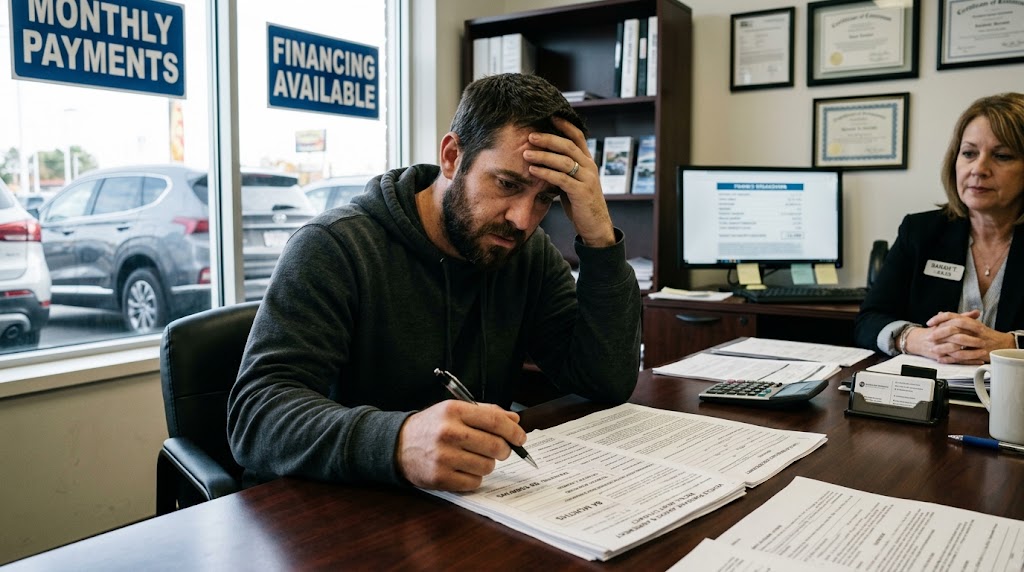
An 84-month auto loan promises a car pay that feels almost painless. Then reality arrives: the vehicle loses value faster than the autoloan balance shrinks, and one day you owe more than the car is worth. Nearly one in four new-car buyers now signs a seven-year deal, and the average car payment keeps setting records. This article follows a composite buyer through the 84-month trap, explains how negative equity builds, and shows the realistic ways out before another dealership visit makes things worse.
Meet Daniel: The $604 Car Payment That Felt Like a Win
Daniel, a composite of buyers who walk into dealerships every day, wanted a $40,000 SUV and a payment under $650. The finance manager stretched his auto loan to 84 months at 7% APR with nothing down. The resulting car pay was about $604, far below the average car payment for new vehicles, so he signed. A 60-month term would have cost $792 monthly, but the longer autoloan added roughly $3,200 in extra interest, and Daniel never saw that number on the contract.
What the Average Car Payment Really Tells You
The average car payment on a financed new vehicle reached a record $777 in the second quarter of 2026, according to Edmunds, and roughly one in five buyers committed to $1,000 or more. Nearly 24% of financed buyers chose terms of 84 months or longer. These headlines make a $604 car pay look modest, yet the average US car payment says nothing about total interest, depreciation, or equity. Comparing your auto loan to the average is a poor budgeting method; comparing it to your income and the car’s resale value works far better.
How the 84-Month Trap Works
Rapid Depreciation Meets Interest-Heavy Early Payments
Every new vehicle drops sharply in value the moment it leaves the lot, and analysts often cite a loss of around 20% within the first year. An 84-month auto loan moves in the opposite direction. Early car pay installments are mostly interest, so only a sliver reduces the principal. After 24 months, Daniel still owed about $30,500 on an SUV worth perhaps $25,000. The car lost value quickly, the autoloan balance barely moved, and the gap between them kept widening.
Being “Underwater” on Your Car Loan
Being underwater, also called negative equity, simply means you owe more than the vehicle is worth. It is harmless while you keep the car, because nobody forces you to sell. The problem appears when life intervenes: an accident that totals the vehicle, a job change, a growing family. Suddenly the insurance payout or trade-in value falls short of the auto loan payoff, yet the car pay obligation remains. Edmunds reported that 29.6% of new-car trade-ins in the second quarter of 2026 carried negative equity, so Daniel’s autoloan situation is far from rare.
The Roll-Over Cycle
At month 36, Daniel wanted a pickup truck. The dealer offered $19,500 for the SUV, but he owed about $25,200, leaving $5,700 of negative equity. Rather than write a check, the salesperson folded that shortfall into the new auto loan. Daniel drove away happy, now financing a $45,000 truck plus $5,700 of old debt for 84 months at 7.9%. His car pay jumped to about $790, well above the average US car payment, and the cycle was officially under way.
Exploding Interest Costs
Rolling debt forward means paying interest on a car you no longer own. Edmunds found that buyers who rolled negative equity into a new deal averaged a $944 monthly payment in the second quarter of 2026, compared with $777 for the average car payment overall. Over seven years, Daniel will pay roughly $15,500 in interest on his second autoloan alone. Each cycle starts at a larger auto loan balance with a longer path to break-even, so the same costly pattern repeats every few years.
Expired Warranties
Then comes the warranty problem. Most factory bumper-to-bumper coverage lasts three to four years, yet an 84-month auto loan runs seven. Around year four, an owner’s repair bills start arriving while the car pay continues for three more years. Owners often end up paying for brakes, sensors, and a transmission service on a vehicle they still owe thousands on. That squeezes the monthly budget exactly when the autoloan balance is still high, which makes escaping the loan through a sale or trade even more difficult.
Is 84 Months Good for a Car Loan?
For most buyers, no. An 84-month auto loan is a tool for lowering the monthly car pay, not the cost of the car, and the comparison below shows why. On a $40,000 loan at 7%, stretching from 60 to 84 months cuts the payment by about $188 but adds roughly $3,200 in interest. The longer term also keeps you underwater for years. If a seven-year term is the only way to afford the vehicle, that is a strong signal to shop for a cheaper car instead of chasing the average car payment.
Auto Loan Term Comparison
| Loan Term | Monthly Car Pay | Total Interest | Total Cost |
|---|---|---|---|
| 60 months | $792 | ≈ $7,500 | ≈ $47,500 |
| 72 months | $682 | ≈ $9,100 | ≈ $49,100 |
| 84 months | $604 | ≈ $10,700 | ≈ $50,700 |
What Is the Best Way Out of a Negative Equity Car Loan?
Learn Your Numbers and Pay Down Principal
Start by learning your real numbers: request a payoff quote from your lender, then compare it to the trade-in and private-sale value. Next, plug the balance, rate, and remaining term into the free auto loan calculator to test what extra principal payments would do. Even $100 added to your monthly car pay shortens the auto loan and cuts interest, while a lump sum from a tax refund attacks the gap directly. Confirm the lender applies extra money to principal and charges no prepayment penalty before sending anything.
Keep the Car, Refinance, or Insure the Gap
If waiting is possible, keep the vehicle and keep making your car pay. Equity often turns positive somewhere in years four to five, because the principal share of each payment grows while depreciation slows. Refinancing can help when your credit has improved, but lenders cap how much they will lend against the car’s value, so a heavily underwater auto loan may be declined. Gap insurance is the safety net in the meantime, covering the difference if the car is totaled. The Consumer Financial Protection Bureau offers a useful guide to auto loan options.
Selling Is the Last Resort
If a private sale brings $19,500 and the payoff is $25,200, you must cover the $5,700 difference in cash or with a personal loan. A personal loan usually carries a higher rate than an auto loan, so use it only after comparing total interest on both. Whatever you choose, never roll the shortfall into another autoloan or car pay. That single decision breaks the cycle Daniel fell into.
Can You Roll $20,000 of Negative Equity Into a Lease?
Technically, sometimes; practically, it is a bad idea. Some dealers can capitalize old debt into a lease, but most lenders limit how much negative equity they will accept, and many refuse it entirely. Rolling $20,000 into a 36-month lease adds roughly $555 to the monthly car pay before finance charges, which can easily double a typical lease payment. You would also pay for the old auto loan and drive a car you will never own, with no equity to show for it.
Better alternatives exist. Pay down part of the shortfall in cash, wait until the gap narrows, or keep the car and focus on extra payments. If you still want a lease, ask the lessor in writing whether it accepts negative equity before you sign, and read the capitalized cost line by line. The Federal Trade Commission explains how auto loan financing and lease terms work, which helps you spot hidden costs. A lease should reduce your car pay, not disguise old debt. Always compare any lease offer against a modest used-car autoloan first.
Frequently Asked Questions
Is 84 months good for a car loan?
Usually not. An 84-month auto loan lowers the monthly car pay but adds thousands in interest and keeps you underwater longer. On a $40,000 loan at 7%, it costs about $3,200 more than a 60-month term. Choose it only if the car is affordable on a shorter schedule.
What is the best way to get out of a negative equity car loan?
Learn your payoff, make extra principal payments, keep the car until equity turns positive, and consider refinancing if your credit improved. Keep gap insurance meanwhile. Sell only as a last resort, and never roll the shortfall into another auto loan.
Is it possible to roll $20,000 of negative equity into a lease?
Sometimes, but many lessors limit or refuse it. Rolling $20,000 into a 36-month lease adds roughly $555 monthly before finance charges, so pay down the gap or wait instead.
What is the average car payment in the US?
Edmunds reported a record $777 for financed new vehicles in the second quarter of 2026, with about one in five buyers paying $1,000 or more. Your budget, not the average car payment, should set your limit.
Ready to Run Your Own Numbers?
Use LoanRateCheck's free calculator to model your payment and explore your full amortization schedule — all in one place, with no registration required.
Open the Calculator →