

Most people spend more time choosing a sofa than understanding their mortgage — yet their mortgage will cost them fifty times or more over their lifetime. This guide changes that. Whether you are trying to make sense of competing home loan quotes, figure out how debt amortization actually works, or find out exactly how much a mortgage loan calculator with extra payments could save you, this article gives you the numbers, the framework, and the practical steps to make a confident decision.
Key Takeaways
- Your monthly mortgage payment has five components — and only one is negotiable with your lender at closing.
- Home loan quotes must be compared at the APR level, not the interest rate, to avoid misleading comparisons.
- Debt amortization front-loads interest, meaning the first years of your mortgage are the most expensive on a per-dollar basis.
- Adding just $100/month in extra principal payments on a $320,000 loan at 6% saves approximately $28,000 over 30 years.
- The best time to start making extra payments is as early as possible — but any time beats never.
What Determines Your Monthly Mortgage Payment
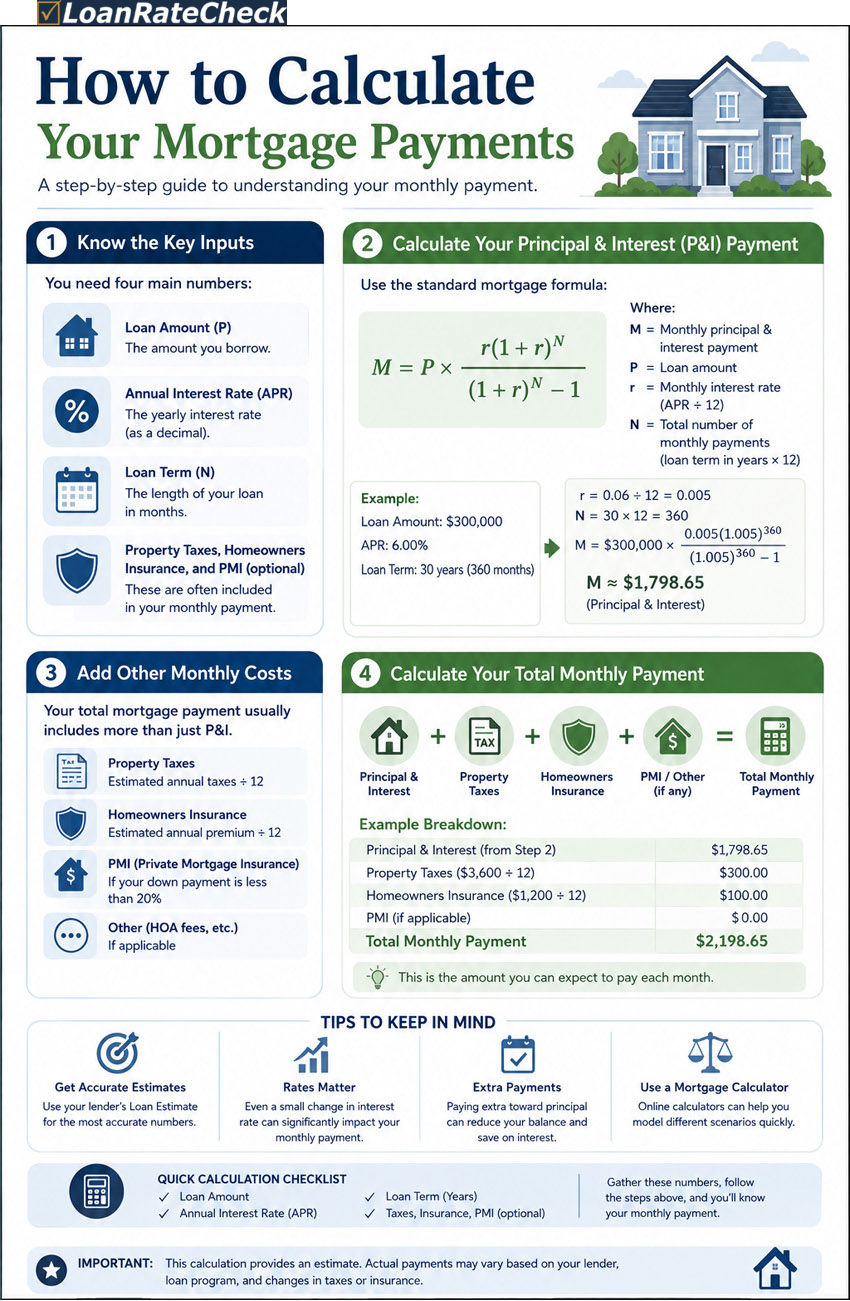
Your monthly mortgage payment is the sum of up to six distinct components. Understanding each one separately is the first step to controlling your total housing cost.
Principal and Interest (P&I): The Core of Every Payment
Principal is the portion of your payment that reduces what you owe. Interest is the lender's charge for providing the loan — calculated monthly as a percentage of your outstanding balance. Together, P&I forms the fixed core of your payment and is determined by three variables: your loan amount, your interest rate, and your loan term. These three inputs feed into the standard amortization formula, which produces an equal payment every month for the life of the loan.
The formula itself is: M = P × [r(1+r)ⁿ] / [(1+r)ⁿ − 1], where M is the monthly payment, P is the loan principal, r is the monthly interest rate (annual rate ÷ 12), and n is the total number of payments (years × 12). On a $320,000 loan at 6% over 30 years, this produces a monthly P&I payment of $1,918.56 — every month, without exception, for 360 months.
Property Taxes: The Variable You Cannot Negotiate
Property taxes are set by your local government and assessed annually as a percentage of your home's assessed value. The national average is roughly 1.1%, but rates range from under 0.3% in Hawaii to over 2.2% in New Jersey and Illinois. On a $400,000 home at 1% annual tax, that is $4,000 per year — $333 added to your monthly payment through your escrow account. Your lender collects this monthly and pays the tax bill on your behalf when it comes due.
Homeowners Insurance, PMI, HOA, and Other Costs
Homeowners insurance protects the structure against fire, storm, and liability. Annual premiums typically run $1,000–$2,500 depending on location, home value, and coverage level. Private Mortgage Insurance (PMI) applies to conventional loans where the down payment is below 20% and typically costs 0.2%–1.5% of the loan amount annually — a cost that exists purely to protect the lender, not you, and that disappears once you reach 20% equity. HOA fees vary from zero to $1,000+ per month depending on the community. Any remaining annual costs — flood insurance, local assessments — can be entered in the Other Costs field of our calculator for a fully loaded monthly estimate.
How to Compare Home Loan Quotes Effectively
Getting multiple home loan quotes is one of the highest-return activities in the entire homebuying process. Research consistently shows that borrowers who obtain quotes from three or more lenders save meaningfully compared to those who accept the first offer — yet a majority of buyers still contact only one lender. Here is how to compare quotes properly so the savings are real, not illusory.
Always Compare APR, Not Just the Interest Rate
The interest rate tells you the annual cost of borrowing the principal. The APR (Annual Percentage Rate) tells you the total cost of the loan including origination fees, discount points, mortgage broker fees, and certain closing costs — spread across the loan term. A lender offering 5.875% with 1 discount point and $3,000 in origination fees may actually be more expensive over 10 years than a lender offering 6.125% with zero points and low fees. APR is the apples-to-apples number. Federal law requires every lender to disclose it clearly on the Loan Estimate form.
Request a Loan Estimate from Every Lender
A Loan Estimate (LE) is a standardised three-page document required by the Consumer Financial Protection Bureau. It details your interest rate, APR, projected monthly payment, estimated closing costs, and cash to close — in a format identical across all lenders. Requesting an LE does not require a full application and does not always trigger a hard credit inquiry (soft pulls are common at the pre-qualification stage). Once you have LEs from three or more lenders, compare page two (closing costs) and page three (APR and total interest paid) side by side before making a decision.
What Makes Home Loan Quotes Vary Between Lenders
Two buyers with identical credit scores can receive substantially different home loan quotes. Key factors that vary between lenders include: their cost of funds and profit margin targets; the loan types they specialise in; their fee structures (some charge higher rates in exchange for lender credits that reduce closing costs); how aggressively they are competing for business at a given moment; and whether they retain or sell their loans on the secondary market. This is why shopping matters — the market for home loan quotes is genuinely competitive, and lenders know it.
When to Lock Your Rate
A rate lock freezes your quoted interest rate for a specified period — typically 30, 45, or 60 days — protecting you from rate increases between application and closing. Locks are free or very low cost for standard periods. If you are still early in the home search process, locking prematurely is risky because you may not find a home before the lock expires. Most buyers lock at the point of accepted offer, when the closing timeline becomes concrete. Ask each lender what their lock extension policy is in case closing is delayed.
Conventional vs. FHA vs. VA — Quick Home Loan Quote Comparison
| Feature | Conventional | FHA | VA | USDA |
|---|---|---|---|---|
| Min. Down Payment | 3–5% | 3.5% | 0% | 0% |
| Min. Credit Score | 620 | 580 (500 w/ 10% down) | No official minimum | 640 |
| Monthly PMI/MIP | If <20% down | Always | None | Annual fee 0.35% |
| Upfront Insurance Fee | None | 1.75% UFMIP | 2.15–3.30% funding fee | 1% guarantee fee |
| Best For | Good credit, 20%+ down | First-time buyers, lower credit | Veterans & service members | Rural/suburban buyers |
| Income Limits | None | None | None | 115% of area median |
Understanding Debt Amortization: The Mechanic That Shapes Every Payment
Debt amortization is the systematic reduction of a loan balance through scheduled, equal payments over time. The word comes from the Old French amortir — to kill — which is apt: amortization gradually kills the debt, payment by payment, until nothing remains. Understanding how it works is fundamental to making smart decisions about your mortgage at every stage.
How the Amortization Formula Allocates Each Payment
Every fixed mortgage payment is split into two parts: interest and principal. The interest portion is calculated first — it is simply your current outstanding balance multiplied by the monthly interest rate. Whatever remains after paying interest reduces your balance. Because the balance is highest at the start of the loan, the interest charge is also highest, leaving the smallest possible principal reduction. As the balance falls, so does the interest charge, and the principal reduction grows correspondingly — even though the total payment never changes.
On a $320,000 loan at 6% over 30 years, the first payment of $1,918.56 breaks down as follows: $1,600 in interest (320,000 × 0.005) and just $318.56 in principal. The second payment: $1,598.41 in interest and $320.15 in principal. By month 180 (year 15), the split has shifted substantially: roughly $1,050 in interest and $868 in principal. By month 300 (year 25), it is approximately $530 in interest and $1,388 in principal. At the final payment, almost the entire amount is principal.
Front-Loaded Interest: Why Your First Years Are the Most Expensive
The front-loading of interest in debt amortization has several important practical implications. First, it means the effective cost of selling or refinancing early in the loan term is higher than it appears — because you have paid mostly interest and built very little equity. Second, it means that extra principal payments have their greatest mathematical impact in the early years, when each extra dollar eliminates the most future interest. Third, it means that 15-year mortgages are not simply a faster version of 30-year loans — they are fundamentally cheaper per dollar borrowed because the front-loading window is shorter and the rate is typically lower.
Negative Amortization: What Happens When Payments Are Too Low
Negative amortization occurs when a scheduled payment is smaller than the interest charge for that period. Rather than reducing the balance, the unpaid interest is added to the principal — meaning the borrower actually owes more after making a payment than before. This occurred with some adjustable-rate and interest-only products during the 2000s housing boom. It does not occur with standard fixed-rate mortgages, but it is worth understanding if you ever encounter loan products with payment caps or deferred interest structures.
Reading and Using Your Amortization Schedule
An amortization schedule is a complete table listing every payment across the life of your loan — typically one row per month — showing the payment amount, the interest portion, the principal portion, cumulative interest paid to date, and the remaining balance. It is one of the most useful documents in personal finance and is almost universally ignored.
What Each Column Tells You
The payment column is constant throughout a fixed-rate loan — your P&I never changes. The interest column starts high and declines every single month, even if only by a few cents in the early years. The principal column starts low and rises every month, mirror-imaging the interest column. The cumulative interest column is often the most sobering — it shows the running total of interest paid to date, making the true cost of the loan visceral rather than abstract. The balance column tells you exactly what you owe at any given moment and is the input for any refinancing break-even calculation.
Using the Amortization Schedule to Track Equity
Your equity at any point in the loan is the difference between your home's current market value and your outstanding balance. The amortization schedule gives you the balance side of that equation precisely. If you purchased at $400,000, put $80,000 down, and your balance after three years is $307,000, your equity from payments alone is $13,000 — plus whatever appreciation has occurred. Most homeowners are surprised by how slowly equity builds from payments in the first five years. Knowing this in advance prevents the shock of discovering, mid-loan, that years of payments have produced modest equity gains.
Amortization Schedule as a Refinancing Tool
If you are considering refinancing, your amortization schedule tells you exactly where you are in the loan's interest cycle. If you are in year three of a 30-year mortgage, you are still in the most interest-intensive portion of the loan. Refinancing into a new 30-year loan restarts the amortization clock — you will again spend the first years paying mostly interest. A 15-year refinance, by contrast, compresses the amortization window dramatically and is often the better choice for borrowers who plan to stay long-term. Compare the total interest remaining on your current schedule to the total interest on the proposed refinance to assess whether the switch is genuinely beneficial.
Using a Mortgage Loan Calculator with Extra Payments
A mortgage loan calculator with extra payments solves a specific and highly practical problem: it tells you exactly how much sooner you will pay off your loan, and exactly how much total interest you will save, if you add a defined amount to your required monthly payment. The calculation is more nuanced than it first appears — which is why a dedicated tool is more reliable than back-of-envelope estimates.
How Extra Payment Calculations Work
When you make an extra payment above your required monthly amount, the excess goes entirely to principal — reducing your balance by that full amount immediately. Next month, your interest charge is calculated on this reduced balance, producing a slightly smaller interest portion in the required payment. That freed-up amount also goes to principal. The effect compounds: each extra payment creates a cascading reduction in future interest charges that grows larger over time. A mortgage loan calculator with extra payments runs this simulation month by month, applying your stated extra amount to principal each period, tracking the resulting balance, and counting months until the balance reaches zero.
Monthly Extra Payments vs. Annual Lump Sums
Both approaches reduce your loan balance and save interest, but they work differently. Monthly extra payments provide immediate, consistent balance reduction — each month's interest is calculated on a lower base. An annual lump sum makes a large one-time reduction but allows interest to accrue at the full rate during the intervening months. The math consistently favours monthly contributions over annual lump sums of the same total value, though the difference is modest. More importantly, monthly contributions tend to be psychologically easier to sustain — they become a habit rather than an annual negotiation with yourself.
Extra Payments by the Numbers: A Practical Reference
The table below shows the impact of extra monthly payments on a $320,000 loan at 6% over 30 years (base monthly P&I: $1,918.56):
| Extra Payment/Mo | New Payoff Term | Months Saved | Total Interest Saved | New Monthly Cost |
|---|---|---|---|---|
| $0 (baseline) | 30 years | — | — | $1,918.56 |
| $50 | 27 yr 7 mo | 29 months | ~$15,800 | $1,968.56 |
| $100 | 25 yr 8 mo | 52 months | ~$28,400 | $2,018.56 |
| $200 | 22 yr 9 mo | 87 months | ~$47,200 | $2,118.56 |
| $300 | 20 yr 7 mo | 113 months | ~$61,900 | $2,218.56 |
| $500 | 17 yr 4 mo | 152 months | ~$88,400 | $2,418.56 |
| $1,000 | 13 yr 1 mo | 203 months | ~$131,500 | $2,918.56 |
* Estimates based on $320,000 loan at 6% fixed rate, 30-year term. Actual results vary by loan balance and rate. Use our mortgage calculator for your specific figures.
The Break-Even on Extra Payments
Unlike refinancing, extra payments have no break-even period. Every dollar of extra principal paid today produces an immediate and guaranteed return equal to your mortgage interest rate — completely risk-free. In a 6% mortgage environment, an extra $100 payment is equivalent to a guaranteed 6% annual return on that $100, which compares favourably to most savings accounts and certificates of deposit. This is why financial planners often recommend prioritising mortgage paydown over low-yield savings instruments, particularly for homeowners who are risk-averse or approaching retirement.
Extra Payment Strategies That Actually Work
Knowing the math is one thing. Building a system that produces consistent extra payments over 10, 20, or 30 years is another. The following strategies are used successfully by homeowners across income levels.
The Bi-Weekly Payment Method
Instead of making 12 monthly payments per year, make half your monthly payment every two weeks. Because there are 52 weeks in a year, this produces 26 half-payments — equivalent to 13 full monthly payments instead of 12. That thirteenth payment goes entirely to principal. On a $320,000 loan at 6%, switching to bi-weekly payments saves approximately $44,000 in interest and eliminates about four years from a 30-year term — without any change to your monthly budget beyond the timing of cash flows. Confirm with your lender that they accept and correctly process bi-weekly payments before setting this up.
The Annual Bonus or Tax Refund Method
Directing some or all of an annual bonus, tax refund, or other windfall to mortgage principal is one of the most impactful uses of unexpected income. A $3,000 lump-sum principal payment in year three of a 6% loan eliminates approximately $7,000–$8,000 in total future interest, depending on the remaining balance and term. The psychological advantage of this method is that it does not require changing your monthly cash flow — you simply allocate income you were not counting on.
The Round-Up Method
Round your monthly payment up to the nearest convenient number. If your required P&I is $1,918.56, pay $2,000 each month — an extra $81.44 that requires no budgeting decision after the first setup. This method works well for borrowers who find automatic transfers easier to sustain than active monthly choices. The $81.44 extra in this example saves approximately $23,000 over the life of the loan and shortens the term by roughly two and a half years.
The Refinance-and-Keep-Paying Method
If you refinance from a 30-year to a lower-rate 30-year loan and your required payment drops, continue paying the original higher amount. The reduction becomes an automatic extra payment every month. This approach captures the rate savings of refinancing while maintaining or accelerating your payoff timeline — the best of both outcomes.
How Loan Type Affects Amortization and Extra Payment Strategy
Not all mortgages amortize in the same way, and loan type affects both the mechanics of extra payments and the strategy around when and how to make them.
Conventional Loans and PMI Removal
For conventional loan borrowers paying PMI, extra payments serve a dual purpose: they reduce total interest and they accelerate the point at which the loan balance reaches 80% of the original purchase price — the threshold at which PMI can be cancelled. On a $400,000 home with 10% down ($40,000), your starting balance is $360,000 and the 80% threshold (requiring PMI cancellation) is $320,000. Extra payments that get you to $320,000 ahead of schedule eliminate both the PMI premium and future interest on the eliminated balance — a compounding benefit that makes early extra payments especially valuable for low-down-payment conventional borrowers.
FHA Loans and MIP: A Different Calculation
FHA loans carry Mortgage Insurance Premiums (MIP) that, for most borrowers with less than 10% down, persist for the full loan term regardless of equity built. Unlike conventional PMI, FHA MIP cannot be cancelled through extra payments alone — it requires a full refinance out of the FHA program. This changes the extra payment calculus: for FHA borrowers, the primary benefit of extra payments is interest reduction and earlier payoff, but eliminating MIP requires a separate refinancing decision when equity and credit profile support a conventional loan qualification.
VA Loans and Funding Fee Amortization
VA loans carry a one-time funding fee (typically 2.15%–3.30% of the loan amount) that is usually rolled into the loan balance rather than paid at closing. This means VA borrowers start with a loan balance higher than the purchase price minus down payment — typically by a few thousand dollars. This rolled-in fee amortizes like any other principal, so VA borrowers benefit from extra payments in the same way as conventional borrowers, with the added advantage of no monthly PMI to eliminate.
Calculating the True Total Cost of Your Home
The sticker price of a home is only the beginning. The true total cost of ownership over a 30-year mortgage is substantially higher, and understanding it in advance prevents the most common form of homebuyer's remorse — feeling like the mortgage is costing more than expected.
The Full Cost Breakdown Over 30 Years
On a $400,000 home purchased with 20% down ($80,000), financed with a $320,000 loan at 6% for 30 years, the costs accumulate as follows: your 360 monthly P&I payments total $690,682 — $320,000 in principal returned and $370,682 in interest paid. Adding estimated property taxes of $120,000 over 30 years (at 1% annually on $400,000), homeowners insurance of $45,000 (at $1,500/year), and other costs of $12,000, you arrive at a total cost of ownership of approximately $947,682 — before maintenance, improvements, or HOA. The $80,000 down payment brings the all-in figure to over $1 million for a home with a $400,000 purchase price. This is not a reason not to buy — home ownership builds equity, provides stability, and historically appreciates — but it is the accurate context within which any mortgage decision should be made.
The Cost of Waiting vs. the Cost of Buying
A common homebuyer dilemma is whether to buy now with a smaller down payment or wait to accumulate a larger one. The calculus depends on local home price appreciation rates, current rent versus projected ownership cost, and how long saving would realistically take. In markets appreciating at 5% annually, a $400,000 home costs $420,000 in year two and $441,000 in year three — a $41,000 increase while you saved. In flat or declining markets, waiting carries less opportunity cost. Use the calculator on this page to model the monthly cost at different down payment levels, then compare to your current rent to determine at what point buying becomes the economically superior option in your specific market.
When Refinancing Makes Sense: A Debt Amortization Perspective
Refinancing is the process of replacing your existing mortgage with a new one — typically to secure a lower interest rate, reduce the monthly payment, shorten the term, or access equity. From a debt amortization perspective, refinancing restarts the amortization clock on the refinanced amount, which has important implications for total interest paid.
The Break-Even Calculation
The break-even point for refinancing is the number of months it takes for your monthly savings to recover the closing costs of the new loan. If closing costs are $6,000 and the new loan saves $200 per month, the break-even is 30 months. If you plan to stay in the home beyond 30 months, refinancing is financially rational. If you plan to move sooner, the upfront cost is not recovered and refinancing hurts you financially. This calculation should be the first step in any refinancing evaluation, before any discussion of rates or terms.
The Amortization Restart Problem
Refinancing from year 10 of a 30-year mortgage into a new 30-year loan extends your total loan timeline to 40 years from original purchase. More importantly, it restarts your amortization at the beginning — putting you back into the most interest-intensive portion of the schedule. Your remaining balance (after 10 years of payments on a $320,000 loan at 6%) is approximately $282,000. Refinancing that into a new 30-year loan at 5.25% produces a lower payment — but you will pay approximately 20 additional years of interest on a balance that was, under the original plan, ten years from being substantially reduced. A 15-year refinance at a competitive rate avoids this problem and is often the better choice for borrowers who are focused on total interest minimisation rather than monthly cash flow relief.
Cash-Out Refinancing and Its Amortization Impact
A cash-out refinance replaces your existing loan with a larger one, with the difference paid to you in cash. The increased balance means higher monthly payments and more total interest — effectively converting equity into debt and restarting the amortization schedule on a larger principal. Cash-out refinancing makes financial sense when the extracted funds are deployed into investments that return more than the mortgage rate (historically, home improvements that increase value, retirement accounts with employer matching, or high-rate debt elimination). It rarely makes sense for discretionary spending, since the amortization cost of the borrowed funds compounds across the remaining loan term.
Frequently Asked Questions
How do I get accurate home loan quotes before applying?
Request Loan Estimates from at least three lenders using identical inputs — same loan amount, term, and down payment. Federal law requires lenders to issue a standardised Loan Estimate within three business days of application. Compare the APR column, not just the interest rate, since APR folds in fees and gives a truer cost picture. Pre-qualification is free and does not affect your credit score, so shop widely before committing.
What is debt amortization and why does it matter?
Debt amortization is the process of paying off a loan through scheduled, equal payments over time — each instalment covering the current month's interest charge with the remainder reducing the principal balance. It matters because the split between interest and principal changes every single month: early payments are mostly interest, late payments are mostly principal. Understanding this helps you decide when extra payments have the greatest impact and whether refinancing makes mathematical sense.
How much can a mortgage loan calculator with extra payments save me?
The savings depend on your loan balance, interest rate, and how much extra you pay. On a typical $320,000 loan at 6% over 30 years, an extra $100 per month saves roughly $28,000 in total interest and shortens the loan by nearly three years. An extra $300 per month saves over $70,000 and cuts more than seven years from the term. Use the Extra Payment tool on our calculator page to model your specific scenario instantly.
Is it better to make one large extra payment per year or small monthly additions?
Monthly extra payments outperform a single annual lump sum of the same total amount because the balance is reduced sooner, meaning less interest accrues in the intervening months. The difference is modest but real — monthly extra payments of $100 save slightly more than a single $1,200 annual payment. However, an annual lump sum is still far better than no extra payment at all, and may suit borrowers whose income is seasonal or bonus-driven.
At what point in the loan does extra principal payment matter most?
Extra principal payments have the greatest mathematical impact in the early years of a loan, when the outstanding balance is highest and each dollar of extra principal eliminates the most future interest. A $1,000 extra payment in year one of a 30-year mortgage saves more than a $1,000 extra payment in year 20, because year one interest is calculated on a much larger balance for a much longer remaining term. That said, extra payments are beneficial at any stage — the key is making them consistently rather than waiting for the "perfect" moment.
How do home loan quotes differ between loan types?
Conventional loan quotes reflect the borrower's credit score, LTV ratio, and market conditions with no government floor. FHA quotes tend to show lower interest rates than conventional offers for the same borrower profile but add mandatory mortgage insurance premiums that raise the effective cost. VA quotes are often the most competitive for eligible borrowers — no PMI and favourable rates — but include a one-time funding fee. USDA quotes feature below-market rates for rural properties but carry income and location eligibility requirements. Always compare total monthly cost, not just the interest rate, across loan types.
Does paying extra on my mortgage affect my amortization schedule?
Yes — every extra principal payment recalculates your effective amortization. The lender does not automatically reissue a new schedule, but the underlying math shifts: your balance is now lower than the original schedule projected, meaning less interest accrues each subsequent month. Over time this causes your loan to pay off ahead of the original schedule. You can model this effect precisely using a mortgage loan calculator with extra payments, which generates a revised payoff timeline based on your additional contributions.
What is the difference between a fixed-rate and adjustable-rate amortization?
A fixed-rate amortization schedule is fully predictable: the same payment amount every month, with a shifting internal split between interest and principal. An adjustable-rate mortgage (ARM) has an amortization schedule that resets when the rate adjusts — typically after an initial fixed period of 3, 5, 7, or 10 years. When the rate rises, more of each payment goes to interest and the payoff timeline can extend. When it falls, the opposite happens. For planning purposes, fixed-rate amortization is far more reliable and is what standard mortgage calculators model.
Ready to Run Your Own Numbers?
Use LoanRateCheck's free mortgage calculator to model your payment, explore your full amortization schedule, and see exactly how extra payments would change your payoff date and total interest — all in one place, with no registration required.
Open the Mortgage Calculator →