

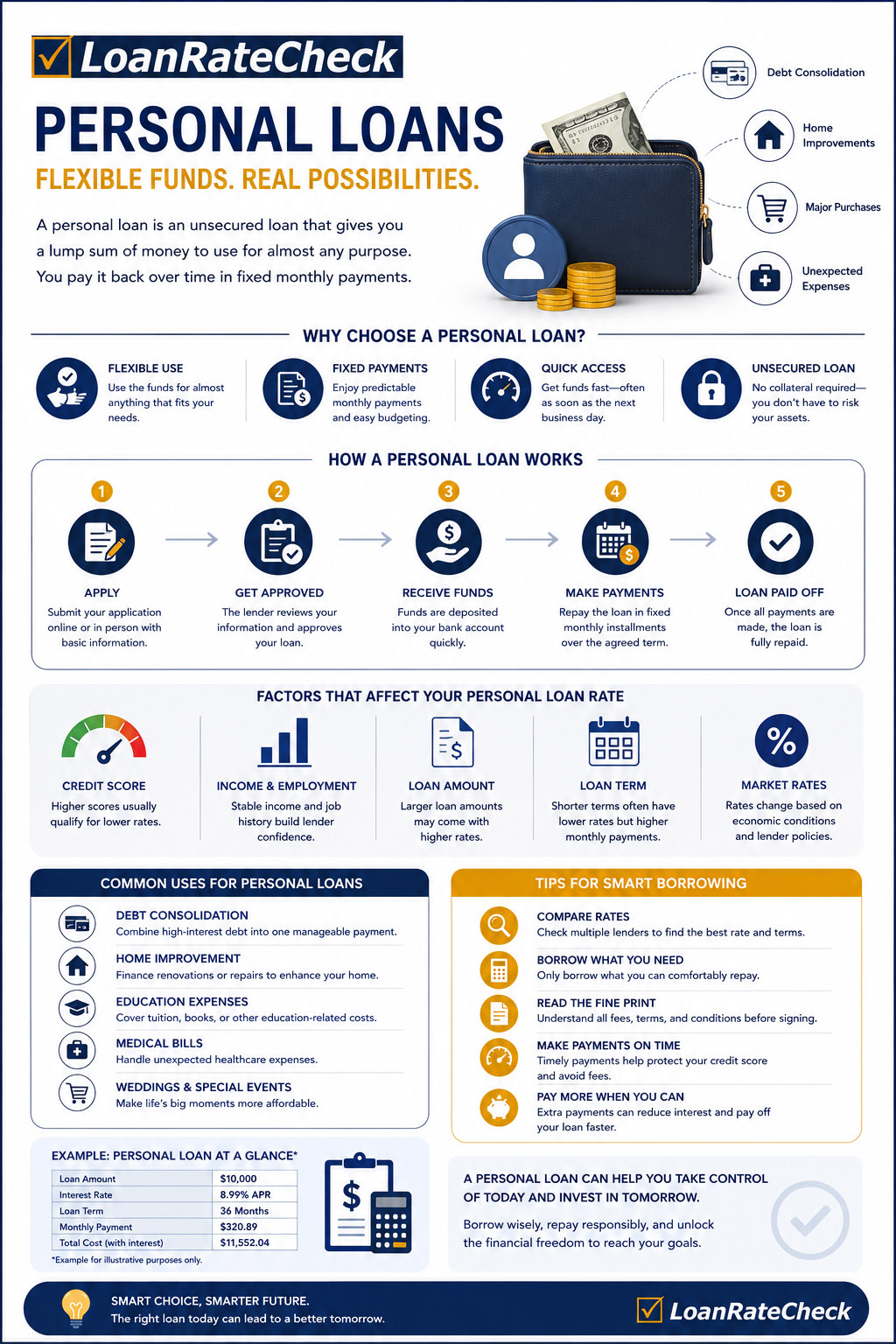
An unsecured personal loan sounds straightforward — borrow money, repay it in fixed monthly instalments, done. But the gap between what lenders advertise and what borrowers actually pay is wide enough to drive a truck through. Whether you are considering personal installment loans for the first time, exploring a personal loan for debt consolidation, or wondering whether adding a co signer will actually help your application — this guide answers the questions lenders rarely volunteer. With the right information and a free loan calculator in hand, you can walk into any application process in control.
Key Takeaways
- Unsecured personal loans require no collateral — but your credit score determines everything about the rate you receive.
- A co-signer can unlock approval or a better rate, but carries significant risk for the co-signer that most lenders understate.
- Personal installment loans are predictable — same payment every month — unlike revolving credit card debt.
- A personal loan for debt consolidation only saves money if the new APR is genuinely lower than your weighted average existing rate.
- Origination fees of 1–8% can add hundreds or thousands to your true cost — always calculate the effective APR.
What Is an Unsecured Personal Loan — and Why Does "Unsecured" Matter?
An unsecured personal loan is a fixed-amount, fixed-rate instalment loan that requires no collateral. You do not pledge your car, home, or savings account against it. The lender's only recourse if you default is reporting to credit bureaus and pursuing collections — they cannot automatically seize an asset. This is fundamentally different from a mortgage (secured by the home) or an auto loan (secured by the vehicle). The trade-off is straightforward: because the lender takes on more risk without collateral, unsecured personal loans carry higher interest rates than secured equivalents for the same borrower profile. According to the Consumer Financial Protection Bureau, personal loan rates currently range from approximately 6% to 36% APR depending on creditworthiness.
The absence of collateral also means approval decisions lean entirely on your financial profile — credit score, income, employment stability, existing debt load, and sometimes the specific loan purpose. Lenders price for risk, so two borrowers applying for identical loan amounts at the same institution on the same day may receive APR quotes that differ by 10 percentage points or more. This is why shopping multiple lenders before accepting any offer is not optional — it is essential. Check current personal loan rates from top lenders here to see the spread before you apply.
How Personal Installment Loans Work — and Why They Beat Credit Cards for Large Expenses
Personal installment loans are structured around predictability. You borrow a fixed amount, agree to a fixed interest rate, and repay in equal monthly instalments over a defined term — typically 12 to 84 months. The payment never changes. That structural certainty is one of the most underappreciated advantages of personal installment loans over revolving credit: with a credit card, your minimum payment fluctuates with your balance, your rate can change at any time, and there is no defined payoff date. Personal installment loans impose a finish line — a specific month when the balance hits zero — which tends to produce better financial outcomes for borrowers managing large, planned expenses.
The amortisation mechanics of personal installment loans mean that early payments are more interest-heavy, and later payments increasingly reduce principal. This is the same front-loaded interest pattern that governs mortgages. For borrowers who plan to pay off early, understanding this curve matters: an extra payment in month three eliminates far more future interest than the same extra payment in month thirty. A personal loan calculator with a full amortisation schedule makes this visible month by month, helping you identify the most effective moments for additional principal payments. Every dollar of extra principal paid reduces the balance on which next month's interest is calculated — a compounding benefit that adds up meaningfully over a multi-year term.
Using a Personal Loan for Debt Consolidation: When the Numbers Actually Work
The idea behind a personal loan for debt consolidation is elegant: replace several high-rate debts — typically credit cards charging 20–30% APR — with a single lower-rate personal loan at a fixed monthly payment. Done correctly, this reduces both the total interest paid and the mental overhead of managing multiple balances and due dates. The math works when your consolidation loan APR is meaningfully lower than your weighted average existing rate, and when you can comfortably make the fixed monthly payment without accumulating new credit card debt simultaneously. Federal Reserve data shows average credit card interest rates now exceed 21% — making well-qualified borrowers who can access personal loan rates in the 9–13% range strong candidates for consolidation savings.
The risk — and it is a behavioural risk, not a mathematical one — is what happens after consolidation. If the spending patterns that generated the credit card debt continue, the borrower ends up with both a personal loan payment and freshly accumulated card balances, a position meaningfully worse than before. The consolidation loan itself did not fail; the decision to treat paid-off cards as available spending capacity did. Before applying for a personal loan for debt consolidation, use this tool to compare consolidation loan rates and run your specific numbers through our debt consolidation calculator — it models your exact saving against credit card minimum payment scenarios, so you see the real dollar difference before committing.
The Co-Signer Question: What Lenders Tell You vs. What You Need to Know
Adding a co signer to a personal loan application is one of the most effective tools available to borrowers with limited credit history or lower credit scores. A co signer — someone with strong credit who agrees to be equally responsible for repaying the loan — essentially lends their creditworthiness to the application. Lenders evaluate the strongest profile on the application, which means a primary borrower with a 620 score and a co signer with a 760 score will likely receive rates closer to the co signer's tier. The practical result can be significant: the difference between a 22% APR and a 12% APR on a $15,000 loan over 48 months is over $3,500 in total interest.
What lenders are less forthcoming about is the full weight of co-signing. A co signer does not simply vouch for the borrower — they become legally equal obligors on the debt. The loan appears on the co signer's credit report, counts toward their debt-to-income ratio when they apply for other credit, and any late payment or default damages their credit score identically to the primary borrower's. The Federal Trade Commission has published guidance specifically warning consumers about co-signing obligations. Before asking anyone to co-sign, both parties should fully understand that the co signer's financial future is directly tied to every payment made — or missed — on that loan.
Hidden Costs That Make Personal Loans More Expensive Than Advertised
The APR a lender advertises in a banner or comparison table is rarely the full cost picture. Origination fees — charged by a majority of online lenders and many banks — typically run 1–8% of the loan amount and are either deducted from your disbursement or added to your balance upfront. A 10.99% APR loan with a 6% origination fee on $20,000 disburses $18,800 to you but requires repayment of the full $20,000 plus interest. The effective APR on the net amount you actually received is materially higher than 10.99%. Per the CFPB, lenders are required under the Truth in Lending Act to disclose APR inclusive of fees, but implementation varies and the disclosed figure is not always the effective APR on the net disbursement. Always calculate effective APR yourself — or use our calculator, which does it automatically.
Beyond origination fees, watch for: late payment fees (typically $15–$40 or 5% of the overdue amount, whichever is greater); prepayment penalties on some lenders' products; and insurance add-ons sold at application — credit life insurance, disability insurance — that are frequently overpriced relative to standalone policies and optional under law, despite sometimes being presented as standard. Check the loan agreement's fee schedule before signing, and decline any add-on product you can source more affordably elsewhere. The combined impact of these costs on a multi-year personal instalment loan can easily exceed several hundred dollars.
Using a Personal Loan Calculator to Protect Yourself Before You Apply
The single most effective thing you can do before accepting any personal loan offer is calculate the numbers yourself — before anyone else frames them for you. Lenders know that most applicants focus on the monthly payment figure rather than the total cost over the loan's lifetime, and product designs reflect that. A personal loan calculator restores the full picture: enter the loan amount, APR, term, and origination fee percentage — and instantly see not just the monthly payment but the total interest, the all-in cost including fees, and the effective APR that accounts for the disbursement shortfall. That effective APR is the number to compare across lenders, not the advertised rate.
Beyond the baseline calculation, an amortisation schedule shows you the exact split between principal and interest for every payment across the entire term. For personal installment loans used for debt consolidation, the calculator also models your saving against credit card minimum payment scenarios — a concrete dollar figure that makes the decision either obvious or worth reconsidering. According to LendingTree, borrowers who pre-calculate and compare at least three lender offers save an average of over $1,000 on personal loans compared to those who accept the first offer. Run your scenario in the calculator first. Then apply.
Unsecured Personal Loan vs. Other Borrowing Options: A Straight Comparison
Personal Loan vs. Alternatives — Key Differences
| Option | Typical APR | Collateral | Payment Structure | Best For |
|---|---|---|---|---|
| Unsecured Personal Loan | 6% – 36% | None | Fixed monthly | Defined expense, predictable budget |
| Credit Card | 18% – 30%+ | None | Revolving / variable | Short-term, paid off monthly |
| Home Equity Loan | 6% – 10% | Home | Fixed monthly | Large sums, homeowners only |
| HELOC | 7% – 11% (variable) | Home | Revolving / variable | Ongoing expenses, homeowners only |
| 401(k) Loan | Prime + 1% | Retirement funds | Fixed monthly | Last resort — lost investment growth |
| Payday Loan | 300% – 400%+ effective | Next paycheck | Lump sum, 2 weeks | Avoid — extremely high cost |
* APR ranges are approximate. An unsecured personal loan sits in a useful middle ground — no collateral risk, defined payoff date, typically far lower cost than credit cards for balances carried more than one billing cycle.
How to Improve Your Personal Loan Approval Odds and Rate
Check and Repair Your Credit Before Applying
Your credit score is the single biggest lever on both your approval odds and your APR. Pull your free credit reports from AnnualCreditReport.com — the only federally mandated free source — and review all three bureau files for errors. Disputed inaccuracies can be corrected within 30–45 days and may materially improve your score. Paying down revolving credit card balances below 30% utilisation before applying can lift your score meaningfully within a single billing cycle. Even a 30-point score improvement can shift you from one rate tier to the next, reducing your APR by several percentage points on an unsecured personal loan.
Pre-Qualify with Multiple Lenders — It Doesn't Hurt Your Score
Most reputable online personal loan lenders now offer pre-qualification using a soft credit pull — meaning you can check your likely rate and loan amount without any impact on your credit score. This lets you compare realistic offers from three to five lenders before choosing which one to formally apply to. Hard inquiries (the full application) do affect your score, but multiple personal loan inquiries made within a 14–45 day window are typically grouped as a single inquiry under both FICO and VantageScore models. Shopping aggressively within that window costs you virtually nothing in credit score terms while potentially saving you thousands in interest over the loan term.
Consider a Co-Signer Carefully
If your credit profile alone does not qualify you for the rate you need, a co signer with strong credit can bridge the gap. But as discussed above, both parties must enter the arrangement with clear eyes about the obligations involved. Before asking someone to co-sign, have an honest conversation about what happens if payments are missed — because the co signer will experience the consequences identically to you. Some lenders allow the co signer to be released from the obligation after a period of on-time payments, which is worth confirming before selecting a lender if co-signer release is part of the plan.
Lower Your Debt-to-Income Ratio First
Lenders evaluate your debt-to-income ratio — monthly debt obligations divided by gross monthly income — as a key underwriting factor alongside credit score. Most prefer a DTI below 36%, with some allowing up to 43–50% for strong credit profiles. Paying off a small existing loan or credit card before applying can shift your DTI meaningfully. Increasing your income — a documented side income or a new job offer letter — also moves this ratio in the right direction. A borrower who reduces their DTI from 42% to 34% may unlock approval at a lender that was previously out of reach, or move into a lower rate tier at a lender that had conditionally approved them.
Whether you are taking out your first unsecured personal loan, using personal installment loans to manage a planned expense, consolidating debt at a lower rate, or navigating the co-signer conversation — the fundamentals are the same: understand the true cost including fees, compare at least three lenders using effective APR not just stated rate, calculate your payment before anyone else frames the number for you, and only borrow what you can comfortably repay within the term. A well-structured personal loan for debt consolidation or a straightforward instalment loan can be a genuinely useful financial tool — or an expensive mistake. The difference usually comes down to how much you knew before you signed.
Frequently Asked Questions
What is the difference between a secured and unsecured personal loan?
A secured personal loan requires collateral — typically a savings account, CD, or vehicle — that the lender can claim if you default. An unsecured personal loan requires no collateral; approval and rate are based entirely on your credit profile and income. Unsecured personal loans typically carry higher rates than secured equivalents for the same borrower because the lender assumes more risk. For borrowers with strong credit, unsecured personal loans are widely available at competitive rates without pledging any asset.
What does a co-signer actually do on a personal loan?
A co-signer becomes equally and legally responsible for repaying the loan. Lenders evaluate the co-signer's credit profile alongside the primary borrower's, which can unlock approval or secure a lower APR when the primary borrower's profile is insufficient on its own. The loan appears on the co-signer's credit report, counts toward their debt-to-income ratio, and any missed payment damages the co-signer's credit score identically to the primary borrower's. Co-signing is a significant financial commitment that carries real risk for the co-signer.
When does a personal loan for debt consolidation actually save money?
A personal loan for debt consolidation saves money when three conditions are met: the personal loan APR is lower than the weighted average rate of the debts being consolidated; the borrower can make the fixed monthly payment comfortably; and the borrower does not accumulate new revolving debt after consolidating. When these conditions hold, total interest paid is reduced and the payoff timeline is defined and finite rather than open-ended. The consolidation calculator at LoanRateCheck models your exact saving against credit card minimum payment scenarios.
How are personal installment loans different from revolving credit?
Personal installment loans have a fixed loan amount, fixed interest rate, fixed monthly payment, and a defined payoff date. You borrow once and repay in equal instalments until the balance is zero. Revolving credit — credit cards and lines of credit — has a credit limit you can borrow against repeatedly, with a minimum payment that fluctuates with your balance and no defined payoff date unless you pay in full. Instalment loans impose financial discipline through their fixed structure; revolving credit requires that discipline from the borrower.
What origination fee is reasonable on a personal loan?
Origination fees on personal loans commonly range from 0% to 8% of the loan amount. Fees of 0–2% are competitive; 3–5% is common among online lenders; fees above 6% are high and should prompt comparison shopping. Some lenders charge no origination fee but compensate with a higher stated APR. The only fair comparison is the effective APR calculated on the net disbursement — which accounts for the fee regardless of how it is structured. Our personal loan calculator computes this automatically.
Can I use a personal loan calculator before applying?
Yes — and you should. A personal loan calculator lets you model any combination of loan amount, APR, term, and origination fee before speaking to any lender. The output includes your monthly payment, total interest, all-in cost, effective APR on the net disbursement, and a full amortisation schedule. This gives you a benchmark to compare against any lender's offer and prevents you from being anchored to the first monthly payment figure you hear. The LoanRateCheck personal loan calculator also models debt consolidation savings versus credit card minimum payments.
Does applying for a personal loan hurt my credit score?
A formal application triggers a hard credit inquiry, which typically reduces your score by 2–5 points temporarily. However, most lenders offer pre-qualification using a soft pull that has no score impact — use this to compare offers. Multiple hard inquiries for personal loans made within a 14–45 day window are typically treated as a single inquiry by major scoring models, so shopping several lenders within that window has minimal additional impact compared to applying to just one.
What is the maximum amount I can borrow with an unsecured personal loan?
Most mainstream lenders offer unsecured personal loans up to $40,000–$50,000, with some specialist online lenders extending to $100,000 for highly qualified borrowers. The amount you qualify for depends on your credit score, income, existing debt obligations (debt-to-income ratio), and the lender's policies. Loans above $25,000–$35,000 may require a co-signer or carry stricter underwriting criteria at some institutions.
Ready to Run Your Own Numbers?
Use LoanRateCheck's free personal loan calculator to model your payment and explore your full amortization schedule — all in one place, with no registration required.
Open the Personal Loan Calculator →