
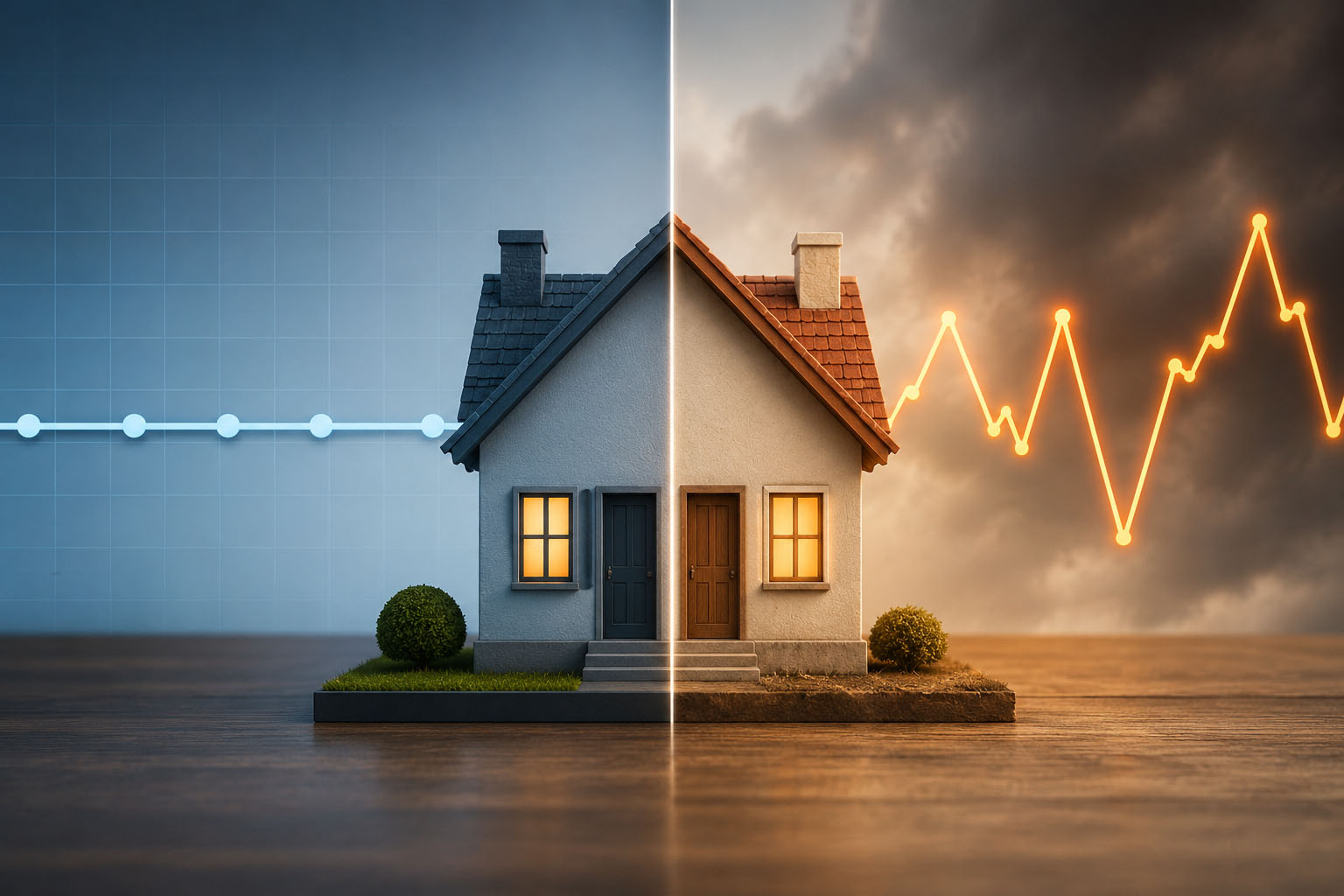
Choosing between a fixed rate vs variable rate loan is one of the biggest financial decisions a borrower makes, and in today's mid-6% mortgage market, the stakes feel higher than ever. Fixed-rate loans lock in predictable payments for the life of the loan, while variable-rate loans start lower but shift with the market later on. Understanding fixed interest vs variable interest isn't just about today's numbers — it's about your timeline, your risk tolerance, and how long you actually plan to keep the loan. This guide breaks down both options so you can decide with real confidence.
Fixed-Rate Loans: Stability, Safety, and What You Give Up
A fixed-rate loan holds the same interest rate and the same monthly principal-and-interest payment from your first payment to your last, whether that's 15 years or 30. This is the classic version of the fixed rate vs variable rate debate: you trade the possibility of a lower starting rate for total predictability. Your rate never moves regardless of what the Federal Reserve does, what inflation does, or what happens in the bond market. That stability is hard to overstate — your housing payment becomes one of the few truly fixed line items in a household budget that otherwise changes constantly.
The Safety Fixed Rates Provide
Safety is the primary appeal in any fixed interest vs variable interest comparison. There's no adjustment period to track, no rate cap to memorize, and no surprise payment jump five or seven years into the loan. This matters most for buyers on a tight budget, those planning to stay in the home for decades, or anyone who simply doesn't want to think about mortgage rates again after closing. According to the Consumer Financial Protection Bureau, predictable payments are one of the main reasons the 30-year fixed-rate mortgage remains the most common loan choice among U.S. homebuyers.
Who Fixed-Rate Loans Fit Best
Fixed-rate loans tend to make the most sense for buyers planning to stay put — families settling into a school district, retirees not planning another move, or anyone who values a payment that never changes over one that might eventually be cheaper. If your household budget has little room for a payment increase, the fixed rate vs variable rate decision often gets simple fast: certainty wins. It's also the more forgiving choice for first-time buyers who are still learning how mortgage markets move and would rather not track an index every year.
The Downside of Locking In
The trade-off is cost. Fixed rates typically start higher than an introductory adjustable rate, so you pay a premium for certainty from day one. If rates fall after you close, you're stuck at your locked-in rate unless you refinance — and refinancing means new closing costs, a new appraisal, and a fresh round of paperwork. Freddie Mac's weekly survey shows the 30-year fixed averaging in the mid-6% range through much of 2026, so today's "safe" rate is still a meaningful monthly cost. Run your own numbers through LoanRateCheck's mortgage calculator before committing, so you know exactly what that stability costs you each month.
Variable-Rate Loans: Lower Start, Real Savings, and Real Risk
A variable-rate loan — usually structured as an adjustable-rate mortgage, or ARM — keeps its rate fixed for an initial window, commonly 5, 7, or 10 years, before adjusting periodically based on a market index. This is where the fixed rate vs variable rate math gets interesting: ARM rates in 2026 typically start meaningfully lower than 30-year fixed rates, sometimes by a percentage point or more. For a borrower who doesn't plan to keep the loan for three decades, that lower introductory rate can translate into thousands of dollars in savings during the years that actually matter to them.
Savings Potential and Flexibility
The appeal goes beyond a lower starting payment. Borrowers who expect to sell, relocate, or refinance within the fixed period effectively get fixed-rate-style stability for the years they'll actually own the home, without paying for decades of certainty they'll never use. Many 2026 buyers are treating ARMs as a bridge strategy — capturing today's lower initial pricing with the intention of refinancing into a permanent loan if rates ease. That flexibility is a meaningful piece of any honest fixed interest vs variable interest comparison, especially for first-time buyers or move-up buyers with a shorter time horizon.
Common ARM Structures
Most ARMs are labeled with two numbers, such as 5/1 or 7/1. The first number is how many years the rate stays fixed; the second is how often it adjusts afterward, usually annually. A 5/1 ARM offers the lowest introductory rate but the shortest safety window, while a 7/1 or 10/1 ARM trades a slightly higher starting rate for more years of stability before the first adjustment. In any fixed rate vs variable rate comparison, matching the fixed period to how long you'll actually own the home is the single most important decision you'll make.
The Downside: Rate Risk
The risk is what happens after the fixed period ends. Once the introductory window closes, your rate adjusts based on an index like SOFR plus a margin, and your payment can rise — sometimes significantly, even with rate caps in place. If you're still in the home when the loan resets and rates haven't fallen, you could face real payment shock. Before choosing a variable-rate loan, model both your best-case and worst-case payment scenarios, and check what refinancing would look like using LoanRateCheck's refinance calculator so a future rate reset never catches you off guard.
Fixed vs Variable at a Glance
| Factor | Fixed-Rate Loan | Variable-Rate Loan (ARM) |
|---|---|---|
| Starting rate | Higher | Typically 0.75%–1.25% lower |
| Payment stability | Same payment for the full term | Fixed for an initial period, then adjusts |
| Best for | Long-term owners, tight budgets | Shorter timelines, planned moves or refinances |
| Main risk | Overpaying if rates fall | Payment increase after the fixed period ends |
Fixed or Variable: Which One Actually Fits You?
There's no universal answer to whether a fixed or variable rate loan is better — it depends almost entirely on your timeline. If you plan to stay in the home for 10 or more years, value predictability, or simply don't want to monitor rate movements, a fixed-rate loan is generally the safer choice. If you're confident you'll move, sell, or refinance within five to seven years, and you want to capture today's lower ARM pricing, a variable-rate loan can make real financial sense. The right call comes down to comparing both scenarios side by side, not picking whichever option sounds less risky on paper.
Should You Go Fixed or Variable in 2026?
Heading into the rest of 2026, most major forecasters — including Fannie Mae, the Mortgage Bankers Association, and Freddie Mac — expect the 30-year fixed rate to hover in the 6.0% to 6.5% range, with only modest relief likely by year-end. That environment is part of why ARMs have regained popularity this year: the initial-rate gap between fixed and adjustable loans has widened, making the savings from a variable-rate loan more tangible than it was a few years ago. If your timeline is short and you're comfortable with some rate uncertainty, 2026 is a reasonable year to at least run the ARM numbers before ruling one out.
Will Interest Rates Go Back to 3%?
Almost certainly not in the near term. The ultra-low rates of 2020–2021 were the product of emergency-era Federal Reserve policy during a global pandemic — a combination most economists don't expect to repeat. The bulk of 2026 forecasts put the 30-year fixed settling somewhere between 5.5% and 6.5% over the next several years, with a slow, gradual drift rather than a sharp drop. Waiting for 3% rates before buying or refinancing means waiting on an outcome most experts consider unlikely for the foreseeable future — which is why comparing fixed interest vs variable interest options today tends to be the more productive strategy.
A Bit of Historical Context
It helps to remember that today's mid-6% rates aren't historically unusual — they're closer to the long-run average than the sub-4% rates many buyers got used to in the 2010s. The 2020-2021 period was the outlier, not the norm. Looking back further, 30-year fixed rates spent much of the 1990s and early 2000s in the 6% to 8% range. That context doesn't make today's fixed interest vs variable interest decision easier, but it does suggest that "waiting for rates to feel normal again" may mean waiting for a number closer to where they already are.
How to Decide Between Fixed and Variable
Before you choose, ask yourself a few direct questions: How many years do you realistically expect to keep this loan? Could you absorb a higher payment if a variable rate adjusts upward? Would refinancing costs eat into the savings an ARM offers you? And how much does payment predictability matter to your household's peace of mind? Answering these honestly — and running both loan types through a calculator side by side — does more to guide the fixed rate vs variable rate decision than any single rate forecast ever will.
Frequently Asked Questions
Is it better to have a fixed or variable rate loan?
It depends on your timeline. A fixed-rate loan is generally better if you plan to stay in the home long-term and want predictable payments. A variable-rate loan can be better if you expect to sell, move, or refinance within five to seven years, since it starts with a lower rate.
Should I go fixed or variable mortgage in 2026?
With 30-year fixed rates expected to stay near 6.0%–6.5% for most of 2026, many short-timeline buyers are considering ARMs to capture a lower initial rate, while long-term owners are generally better served by locking in a fixed rate for full payment stability.
Will interest rates go back to 3%?
Most 2026 forecasts do not expect rates to return to the 3% range seen in 2020-2021, since those rates were driven by emergency pandemic-era policy. Experts generally project the 30-year fixed to settle between 5.5% and 6.5% over the next several years.
What is the main risk of a variable-rate loan?
The main risk is payment increases after the initial fixed period ends, when the rate adjusts based on a market index plus a margin. Rate caps limit how much it can rise, but your payment can still increase meaningfully.
Can I switch from a variable rate to a fixed rate later?
Yes, through refinancing. Many borrowers choose an ARM specifically to refinance into a fixed-rate loan later if rates improve, though refinancing involves new closing costs and qualification requirements.
Ready to Run Your Own Numbers?
Use LoanRateCheck's free calculator to model your payment and explore your full amortization schedule — all in one place, with no registration required.
Open the Calculator →