
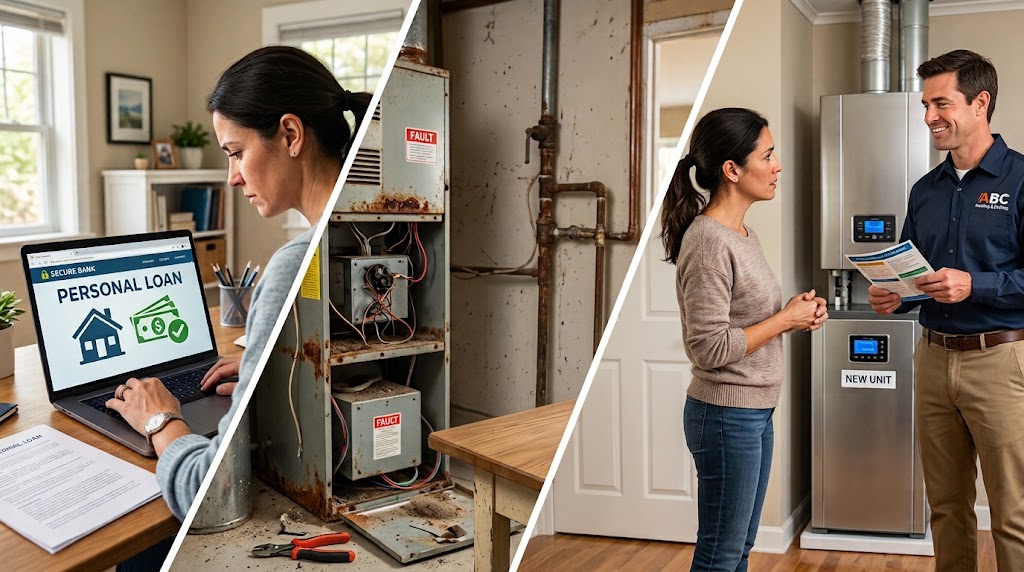
Nobody plans for an HVAC failure. The furnace quits on the coldest night of the year, or the AC dies mid-July, and suddenly you're facing a $6,000–$15,000 bill with no real time to shop around. Most homeowners in this spot reach for whatever hvac financing options the installer offers on the spot. That convenience has a cost, and understanding it before you sign can mean the difference between a fair hvac payment and one padded with fees you never see itemized.
Contractor Financing: Fast, But Not Always Fair
When a technician tells you the compressor is shot and hands you a tablet to apply for financing right there in your kitchen, the appeal is obvious. Contractor financing exists precisely for this moment — no operational HVAC system, no time to compare five lenders, no patience left for paperwork. Most HVAC dealers partner with a financing platform (Wisetack, EnerBank, Service Finance, and similar lenders are common names behind the scenes) that runs a soft credit check and returns an approval in minutes. For a genuine emergency, that speed has real value.
The Convenience Is Real
You get one application, one signature, and installation the same day or the next morning. There's no separate loan closing to coordinate with the install date, and the contractor handles the paperwork. For a household with no working heat or cooling, this single-step process is a legitimate advantage that a traditional lender usually can't match on turnaround time.
Promotional Rates — and the Catch Behind Them
Contractors frequently advertise "0% for 18 months" or "same-as-cash" promotions, and these aren't fake. The financing is real and the promotional rate is real. What most homeowners never see is the dealer fee the lender charges the contractor for offering that promotion — typically 8% to 25% of the financed amount for deferred-interest or true 0% offers, compared to roughly 0% to 6% for a standard interest-bearing installment loan arranged the same way. Contractors rarely absorb that fee. It gets built into the equipment price before you ever see a number, which is why the same furnace can be quoted at noticeably different prices depending on whether you finance or pay cash.
Limited Choice, One Lender
The other tradeoff is that you're comparing exactly one offer. A contractor typically works with one or two financing partners, and you see whatever term and rate that relationship produces that day. There's no shopping the rate against a credit union, no comparing origination fees, and no leverage to negotiate — the contractor already has your business the moment you're mid-emergency. If your hvac payment ends up higher than it should be, you often won't know until you compare it against other financing later.
This matters more on air conditioner financing deals than most homeowners expect, since central AC replacements tend to run $2,000–$4,000 higher than a furnace-only swap, which means a padded dealer fee translates into a larger dollar amount over the life of the loan. A single percentage point of difference on a $12,000 system adds up to real money across a five- or seven-year term, which is exactly why a second opinion — even a quick one — is worth the extra hour it takes.
This is exactly where running the numbers on a personal loan calculator before you sign the contractor's paperwork pays off — even a five-minute comparison can reveal whether the "0% promo" quote is actually the better deal once the built-in dealer fee is accounted for.
Personal Loans: Slower to Arrange, Often Cheaper Overall
A personal loan for HVAC replacement works differently. You apply with a bank, credit union, or online lender independent of the contractor, and the money lands in your account (or is paid directly to the contractor) to use however you choose. This separation from the sales process is the entire advantage — and also the entire tradeoff, since it usually takes more time than a same-day contractor approval.
Rate Shopping Actually Works Here
Because a personal loan isn't tied to a specific contractor's financing partner, you can compare rates from several lenders before committing. Checking rates with 3–4 lenders typically involves only soft credit pulls, so shopping around doesn't damage your credit score. For a well-qualified borrower, this comparison shopping alone often beats a contractor's standard-rate offer by a percentage point or more — real savings on a $10,000–$15,000 loan over 60–84 months.
Versatility Beyond the Equipment
A personal loan isn't restricted to the HVAC unit itself. If the emergency also uncovered ductwork problems, an electrical panel upgrade, or drywall repair from a leak, one loan can cover the whole project instead of forcing you to patch together financing from multiple contractors. This flexibility is one of the most underrated advantages of going outside the contractor's financing desk.
No Hidden Dealer Markups
Because the lender isn't paying the contractor a dealer fee to originate your loan, there's no built-in incentive to inflate the equipment price. What you're quoted for the furnace or AC unit is closer to the contractor's actual price, separate from the cost of the money. Comparing the equipment-only quote against a financed quote from the same contractor is one of the fastest ways to spot how much of a "financing markup" you might otherwise be paying.
Speed Varies by Lender
This is the real tradeoff. Some online lenders fund a personal loan within one business day, which works fine for many emergency replacements. Others — particularly credit unions with the best rates — take three to five business days to fund, which may not align with "the furnace is out tonight" urgency. If the system failure is severe enough to need same-day replacement, a personal loan may need to be paired with a short-term deposit or a smaller upfront payment while the loan funds.
Before comparing offers side by side, run your expected loan amount and term through a personal loan calculator to see the real monthly payment and total interest — then hold that number next to the contractor's financing quote for an apples-to-apples comparison.
No Credit Check HVAC Financing: When It's Worth It
For homeowners with damaged or thin credit, "no credit check" HVAC financing ads can look like the only door open. It's important to understand what's actually being offered: most no-credit-check programs are lease-to-own or rent-to-own agreements, not loans. You're leasing the equipment with an option to own it once the lease term ends, and approval is based on income and bank account history rather than a credit score.
What You're Actually Signing
Because these are lease agreements rather than credit products, they're often structured outside standard state interest-rate caps that apply to loans. The tradeoff for skipping the credit check is a materially higher total cost — homeowners in this position frequently end up paying well above the unit's retail price by the time the lease is paid off. Some agreements include early-payoff discounts that meaningfully reduce that gap if you can pay the balance down faster than scheduled, so reading that clause matters more than almost anything else in the contract.
Where It Fits
No-credit-check leasing has a legitimate place: a genuine no-heat or no-AC emergency, a credit score too low for standard installment financing, and no time to explore other paths. In that narrow situation, it restores comfort and safety immediately. Outside of that specific scenario, it's almost always the most expensive of the three hvac financing options covered here, and it's worth a phone call to a credit union or a check of subprime personal loan programs before signing a multi-year lease.
Building a Decision Framework
When the system fails, work through the choice in this order: First, check whether the timeline truly requires same-day financing, or whether a 24–48 hour window exists for a personal loan to fund. Second, if time allows, get the contractor's financed price and their cash price separately — the gap between them reveals the built-in dealer fee. Third, run that same loan amount through a personal loan calculator using rates from at least two outside lenders. Fourth, only consider a no-credit-check lease if standard financing genuinely isn't available to you.
A $12,000 furnace and AC replacement financed at a contractor's promotional 0% rate might carry a 15% dealer fee baked into the price — effectively $1,800 added before interest is even calculated. The same $12,000 borrowed as a personal loan at a market rate, after comparing two or three lenders, frequently produces a lower total cost even though it technically charges interest. The only way to know for certain in your specific case is to run both numbers side by side before the contractor leaves your driveway.
A Quick Gut Check Before You Sign
Ask the contractor for the equipment's cash price in writing, separate from the financed quote — a legitimate business will provide this without hesitation. If they can't or won't separate the two, treat that as a signal to slow down and get a second quote. Emergency repairs are stressful, but the fifteen minutes it takes to ask that question and check a loan calculator is rarely the difference between having heat tonight and having heat tomorrow — it's usually the difference between a fair price and an inflated one.
Frequently Asked Questions
Is contractor financing or a personal loan better for HVAC financing?
It depends on your timeline and credit profile. Contractor financing wins on speed and convenience for genuine emergencies, but a personal loan usually wins on total cost because you can rate-shop and avoid the dealer fee built into many contractor promotions. If you have even 24–48 hours before installation is required, comparing both is worth the effort.
Why do 0% HVAC financing offers cost more than they seem?
True 0% or "same-as-cash" promotions are funded by a dealer fee the lender charges the contractor — commonly 8% to 25% of the financed amount. Contractors typically build that fee into the equipment price rather than absorbing it, so the "free" financing is often paid for through a higher upfront price rather than through interest.
What is no credit check HVAC financing?
Most no-credit-check HVAC offers are lease-to-own or rent-to-own agreements rather than loans. Approval is based on income and banking history instead of a credit score, but because they're structured as leases, they often fall outside standard interest-rate caps and can cost significantly more than the equipment's retail price over the full term.
How fast can I get approved for a personal loan for HVAC replacement?
Approval speed varies by lender. Many online personal loan lenders approve and fund within one business day, while credit unions and banks — often offering the lowest rates — may take three to five business days. If your system failure requires same-day installation, factor funding speed into which lender you choose, not just the rate.
Will shopping multiple lenders for an HVAC loan hurt my credit score?
Generally no. Most personal loan lenders use a soft credit pull to generate a rate quote, which doesn't affect your credit score. Only after you formally accept an offer does a hard inquiry typically occur, so comparing 3–4 lenders before choosing one is low-risk and can meaningfully lower your rate.
Can a personal loan cover more than just the HVAC unit?
Yes. Unlike contractor financing, which is usually tied to the specific job being quoted, a personal loan's funds are unrestricted. If the HVAC failure also revealed ductwork, electrical, or water damage repairs, one personal loan can often cover the entire project instead of financing each piece separately.
What HVAC financing option should I choose in a true emergency?
If there is zero time to shop — no heat in freezing temperatures or no AC during a heat warning — contractor financing or a fast-funding personal loan are your realistic options. Reserve no-credit-check leasing for situations where standard financing genuinely isn't available, since it's typically the most expensive of the three hvac financing options over the full term.
Ready to Run Your Own Numbers?
Use LoanRateCheck's free calculator to model your payment and explore your full amortization schedule — all in one place, with no registration required.
Open the Calculator →