
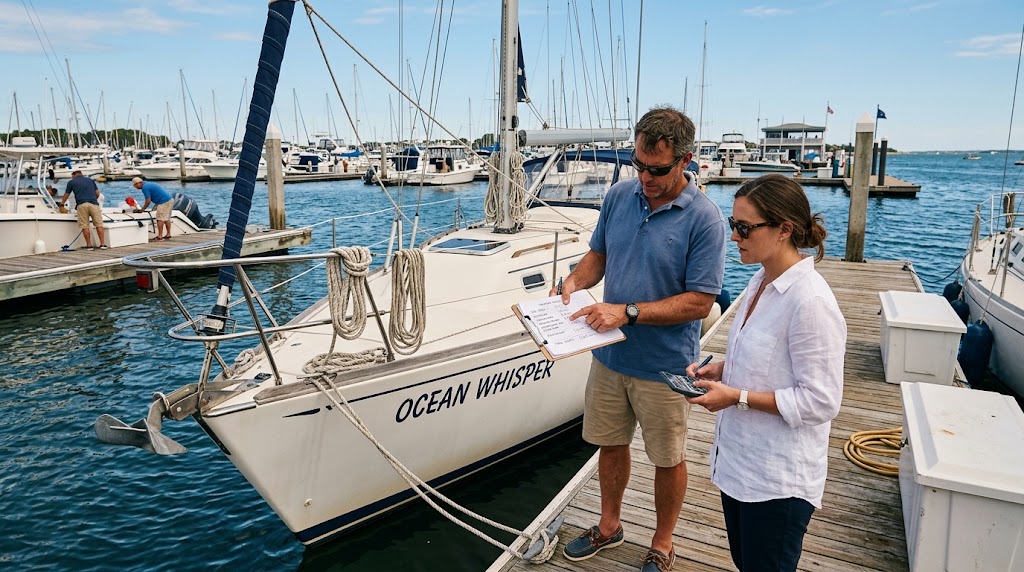
A boat loan payment looks manageable until the marina sends its rate sheet. On a $75,000 boat kept in saltwater, the monthly note is only about a third of the real bill, because slip fees, corrosion-driven boat upkeep, and higher insurance stack on top of it. This guide breaks down saltwater operating costs, compares them with freshwater ownership, and shows how to stress-test your budget with a boatloancalculator before you sign. Run the numbers first, and the water you choose stops being a surprise expense and becomes a plan.
The Reality of Saltwater Operating Costs
Saltwater is relentless. Salt crystals creep into wiring, seize fasteners, pit stainless hardware, and consume sacrificial anodes that a freshwater boat barely notices. Barnacles and slime colonize an unprotected hull within weeks, which means regular bottom paint, haul-outs, and pressure washing. Engines need a fresh-water flush after every trip, and raw-water cooling parts wear faster. None of this is dramatic on a single invoice, but boat upkeep in a marine environment is a steady drip that adds up to thousands each year, and lenders never fold it into your monthly loan payment.
The second surprise is the slip. Waterfront real estate is scarce, so marinas price wet slips by the foot, often adding charges for electricity, water, pump-outs, and seasonal surcharges. A 28-foot boat can easily cost several hundred dollars monthly in a popular coastal harbor, and rates typically rise every year. Waitlists are common, so the slip you budgeted for may not exist when the boat arrives. Ask every marina for a written quote, and treat it as a fixed obligation that sits beside your boat loan, not a footnote.
Insurance and service complete the picture. Underwriters price coastal storm exposure higher, and hurricane-zone policies often carry named-storm deductibles or navigation limits. Meanwhile, hiring a qualified marine maintenance service for winterizing, engine work, and hull repairs means paying professional labor rates, and parts from a local harbor marine maintenance & supply store add up quickly. Owners who do their own work save labor but still buy the supplies. Whatever your approach, build these recurring items into the budget before you compare any boat loan offers.
Direct Comparison: Freshwater vs. Saltwater Affordability
The table below models the same \$75,000 boat financed with 10% down over 15 years at 7.5% APR, which produces a payment of about \$626 a month on a \$67,500 loan. Only the operating environment changes. These figures are illustrative estimates, not quotes, and your local slip rates, insurance profile, and boat type will move them. Still, the pattern holds nearly everywhere: identical debt, very different cost of living with the boat. Use it as a template, then replace each line with a real quote from your marina, insurer, and marine maintenance service.
| Monthly Cost Category | Freshwater | Saltwater (Wet Slip) |
|---|---|---|
| Base Loan Payment | $626 | $626 |
| Storage / Slip Fees | $250 | $650 |
| Maintenance & Upkeep | $250 | $425 |
| Insurance Premiums | $78 | $125 |
| Total All-In Est. | $1,204 | $1,826 |
Saltwater ownership costs roughly \$622 more each month, about 52% higher, or nearly \$7,500 a year. Notice that the loan payment is identical in both columns, so a lender comparing only debt would call these two buyers equals. The gap comes entirely from slip fees and boat upkeep. Some of it is negotiable, since marina choice, haul-out frequency, and insurance deductibles all shift the total. Before shopping rates, including navy federal boat loan rates and other credit union offers, decide which column you actually live in.
Total Monthly Cost of Boat Ownership ($75,000 Boat)
Read each bar from left to right: the blue segment is the loan, and it is the same length every time. Everything after it is what the boat costs to live with. Dry stack storage lands between the extremes at roughly \$1,511 a month, while freshwater sits near \$1,204. Hover over or tap any segment to see its label and monthly value. If the saltwater bar strains your budget, the fix is rarely a smaller loan payment alone. Change the storage model, the hull, or the water before you change the interest rate.
How to Calculate Your True Debt-to-Income (DTI) Ratio
Lenders calculate DTI by dividing your monthly debt payments by your gross monthly income, and the CFPB explains why 43% became a widely cited benchmark. Suppose you earn \$7,500 monthly and already pay \$2,600 toward housing and other debts, a 34.7% ratio. Add the \$626 boat note and DTI reaches 43.0%. That is the lender's view. Your cash-flow view is harsher, because slip fees and boat upkeep are real monthly costs even though they never appear on a credit report.
Calculate Fixed Capital Outlays
Start with every fixed outlay tied to the purchase: down payment, sales tax, registration, survey, sea trial, and the first year of insurance. Then add the recurring items from the comparison above. In our example, all-in boat costs of \$1,826 push total monthly obligations to \$4,426, a true cash-flow DTI near 59%. Enter your own price, rate, and term into our boatloancalculator to lock in the payment line, then layer the other costs on top. Seeing 59% instead of 43% is uncomfortable, and that is exactly why you do this early.
Obtain Local Slip Quotes Early
Call marinas before you make an offer, not after closing. Ask for the monthly rate for your boat's length and beam, utility surcharges, annual increases, deposit requirements, and waitlist length. Collect at least three written quotes, including one dry stack facility, and compare them against what a marine maintenance service charges for hauling and bottom work at each yard. A slip quote that arrives after you own the boat is a bill; one that arrives before is a negotiating tool. It can even change which boat you shortlist, since length drives nearly every marina charge.
Establish a Secondary Maintenance Escrow
Open a separate savings account and fund it every month with one-twelfth of your annual boat upkeep estimate, about \$425 in our saltwater example. Haul-outs, anodes, impellers, batteries, and engine service arrive unpredictably, and an escrow keeps them off your credit card. Treat the balance like a second loan payment that you owe to yourself. Owners who skip this step often defer maintenance, which turns small corrosion problems into expensive repairs. The escrow also gives you a real spending record to bring back to the boat loan calculator when you plan your next upgrade.
Risk Mitigation Strategies for Saltwater Boat Owners
Dry Stack Storage
Dry stack facilities store your boat on a rack and launch it by forklift when you call ahead. Because the hull stays out of the water, bottom paint, marine growth, and blistering risk drop sharply, and many owners report fewer haul-outs and lighter marine maintenance service bills. In our model, dry stack trims about \$315 a month compared with a wet slip. The trade-offs are launch scheduling, less spontaneity, and size limits, since racks typically favor boats under about 40 feet. For many coastal owners, the trade is well worth it.
Buy a Freshwater-Used Hull
A hull that spent its life on a lake or river usually shows less corrosion, cleaner engine internals, and fewer electrical gremlins than a coastal twin of the same age. That can lower both the price you pay and the boat upkeep you inherit. Still, hire an independent surveyor and a marine mechanic before closing, since fresh water is no guarantee of good care, and remember that the corrosion clock starts once the boat moves to salt. Confirm engine hours, trailer condition, and hull integrity, and get parts pricing from a local harbor marine maintenance & supply shop.
Comparing Navy Federal Boat Loan Rates and Other Lenders
Once you know what you can carry, compare lenders. Credit unions are worth a quote if you qualify for membership, because navy federal boat loan rates and terms vary with credit score, down payment, loan amount, and boat age, and published ranges change often. Request written offers from at least three lenders, compare APR and term rather than payment alone, and check for prepayment penalties. Then run each offer through our boat loan calculator to see total interest before choosing.
Frequently Asked Questions
What is the most expensive part of owning a boat?
For most owners it is the combination of depreciation, storage, and maintenance rather than the loan itself. Depreciation stays invisible until you sell, but slip fees and boat upkeep hit your account every month. In saltwater, storage alone can rival the loan payment, as in our $75,000 example where the slip costs $650 against a $626 note. The largest single line depends on your boat, location, and financing terms, so ask each marina and insurer for quotes to see which one dominates for you.
Is it hard to finance a yacht?
It is harder than financing a small boat, but far from impossible. Larger vessels typically require bigger down payments, strong credit, documented income, and a professional marine survey, and lenders may limit loan terms or vessel age. Expect more paperwork and a longer approval process. A clear budget that includes slip fees and upkeep, plus quotes from several marine lenders, improves both your approval odds and your rate. Working with a lender that specializes in marine loans can also smooth the process.
Are Navy Federal boat loan rates better than other lenders?
Navy Federal boat loan rates depend on credit, term, and boat age, and membership is limited to eligible military-connected members and families, so they may or may not beat a bank or marine lender for you. Get written quotes from at least three lenders, compare APR and total interest, and use the boat loan calculator to test each offer against your budget. Also confirm fees, prepayment terms, and whether the boat's type and age qualify for financing before you apply.
Ready to Run Your Own Numbers?
Use LoanRateCheck's free boat loan calculator to model your payment and explore your full amortization schedule — all in one place, with no registration required.
Open the Calculator →